Early Indians by Tony Joseph

I gave this book a second shot after dropping it over a year ago. A friend insisted it was an informative read, so I dove back in despite the denseness of the author’s writing. I still found the writing to be strained, and the author struggles with explaining scientific concepts and genomic research fluidly. His writing about history is much more enjoyable to read, but the science is necessary to comprehend the history which made the overall read a tad arduous. The effort is worth it though – I personally learnt a lot about Indian pre-history, the answers that DNA research has now brought to light that didn’t exist even 10 years ago, and how that corroborates or contradicts stories and theories I’ve heard growing up.

On Writings and Maps

My other overall gripe with this book is the poor use of imagery and maps. They exist, yes, but they were undoubtedly added as an after-thought. Perhaps the editor thought the sub-200 paged book would ‘not cut it’ and added padding with some maps and illustrations. Whatever the reason, the book could have benefitted from illustrations that were more relevant, and better placed with the narratives.

Example below depicts my annoyance: the page on the left is incomplete, with a half-sentence hanging off that would need the reader to flip past the map to complete the author’s train of thought. In doing so, oops, you’ve now skipped the map that would have helped understand the geography of what the author is speaking about, so you need to go back.

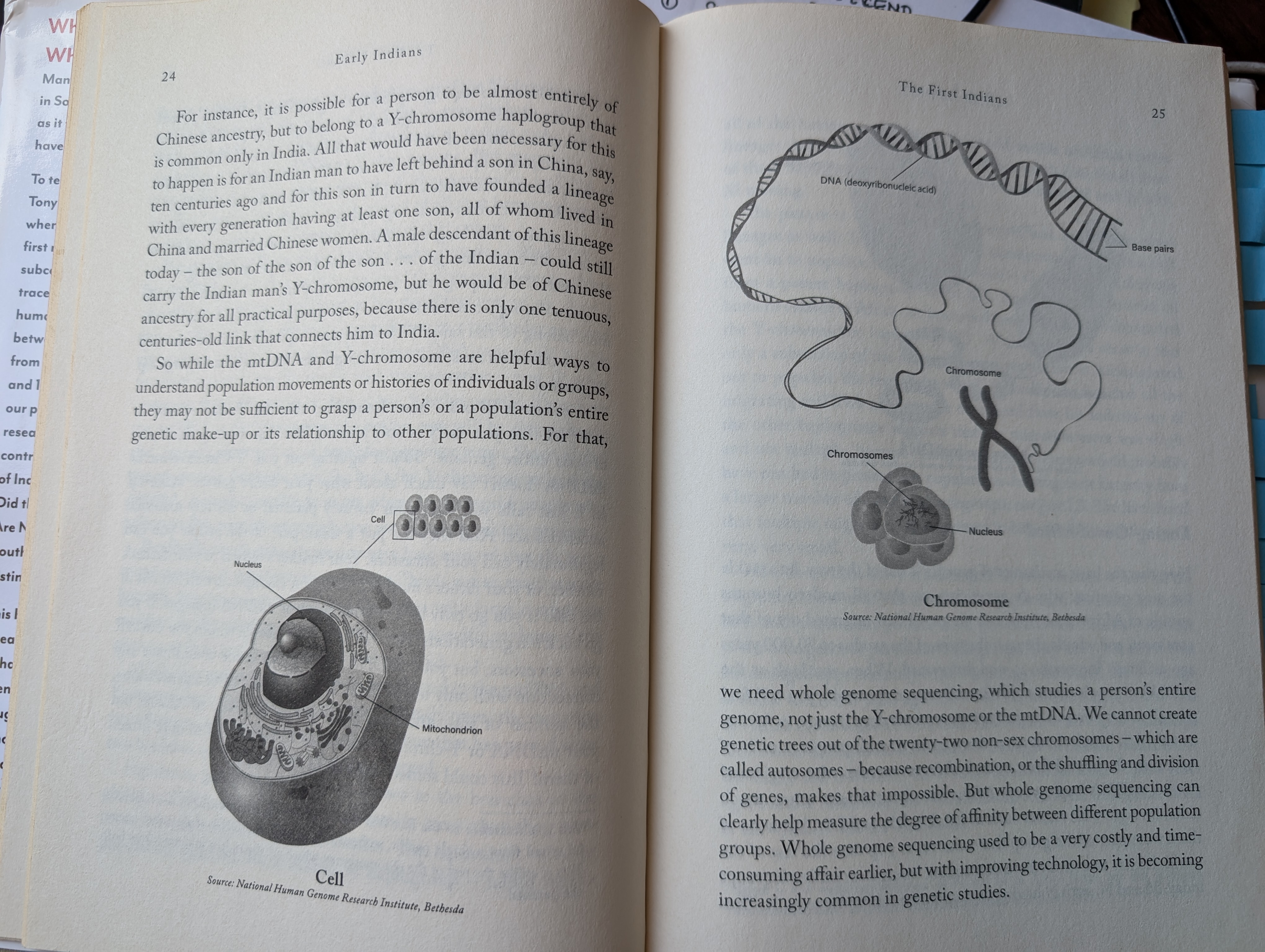
Sometimes, the images are irrelevant to the current topics of dense, scientific explanations – this left me infuriated a couple of times. Here is a page from early in the book where the author sets out to explain some pretty complicated genomic science, how mtDNA and Y-chromosomes are passed along generations, and how they have been helpful in our current understanding of history alongside archeological evidence. Alongside this complexity, we get some fairly irrelevant cell diagrams: the connect is ‘biology’, I guess?
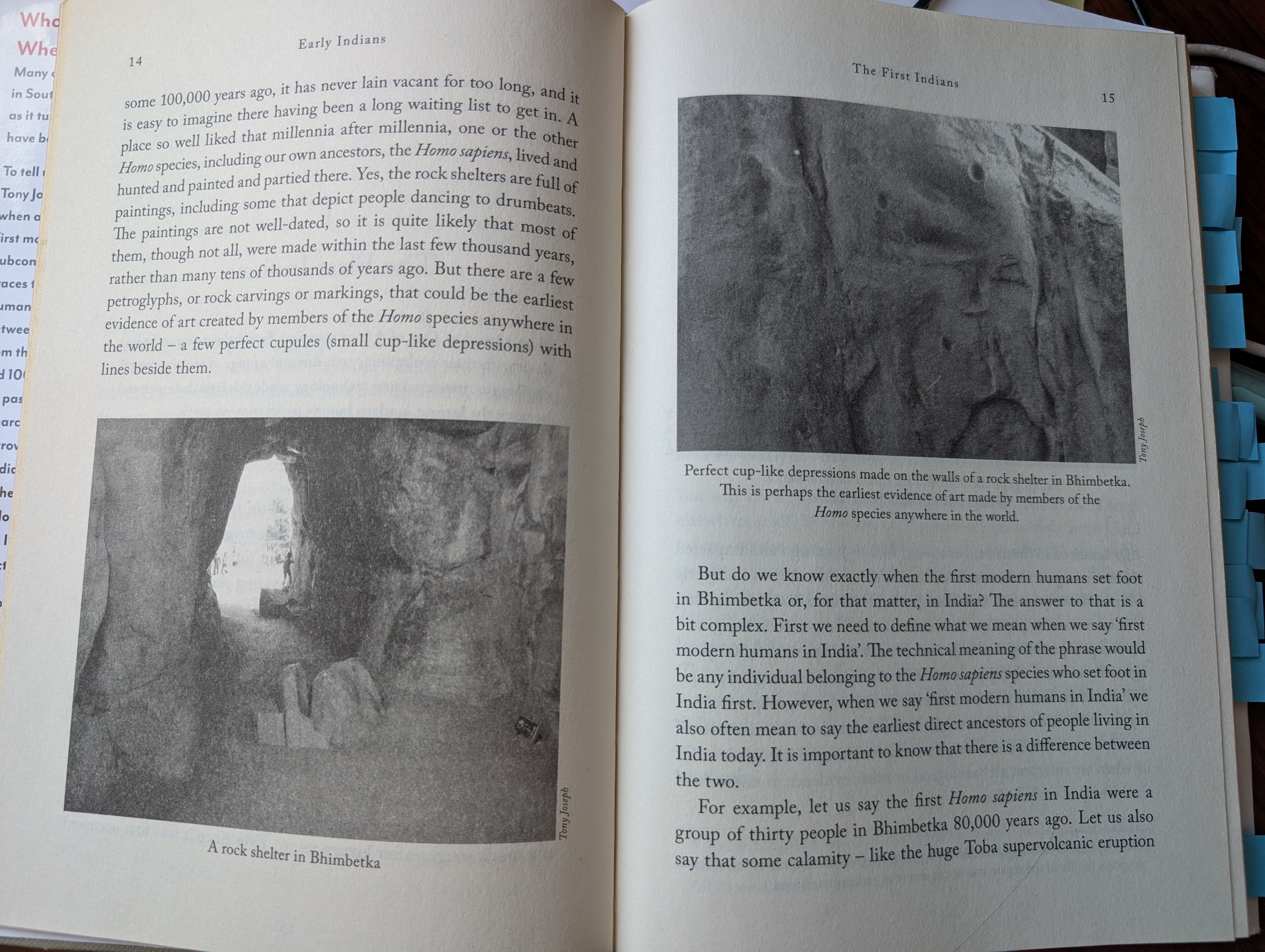
Here’s another page for comparison where I’d argue that the architecture of the prose and imagery were done right! We have the author narrating early Indian evidence and humanity’s first artistic endeavors from the Bhimbetka caves in Madhya Pradesh, and after a crisply ended sentence we see images of both the caves, and the early Homo Sapiens’ art in the photos provided – we just needed more of these, and less of the cases above! Would have made the read a lot more pleasant!
Fascinating Lessons

Alright, gripes about the editing of the book aside, here are some fascinating things I learnt from this read!

  1. India has not invested enough in the understanding of our early history. The resources provided to archeology seem quite minimal, leaving a lot of unturned places of history. Tony Joseph says that one of the places we should visit to get a sense of the grandeur of the Harappan Civilization would be to visit Dholavira in the Great Rann of Kutch in Gujarat, a 7 hour drive from Ahmedabad. Dholavira was a crucial hub for the Harappan Civilization’s overseas trade with Mesopotamia!
  2. Unicorns were a part of Proto-Indian history too! The commonest seal in the Harappan Civilization, about 60% of all discovered seals have the image of a unicorn. So much so that it is believed to have been a ‘state symbol’ similar in importance to the Ashoka Chakra today. (Did anyone else think Unicorns were a western fascination?)
  3. Reconstructed Proto-Dravidian vocabulary helps identify the timing of when Proto-Zagrosian and Proto-Dravidian languages (and hence people) separated: not before animals like goat and sheep were domesticated, or early forms of agriculture, but not after writing was invented. ‘Tal’ which means to push in Proto-Dravidian, means to ‘write’ in Elamite (language spoken in Elam, in present day Iran). McAlpin explains that the original meaning of ‘Tal’ was to ‘push in’, and since early cuneiform writing involved clay tablets with the same action, the word went on to take the second meaning of ‘writing’ in Elamite after writing was invented. Proto-Dravidians must have separated from Elamites before writing was invented, and therefore the word never acquired this meaning! The word for writing in Dravidian languages instead derives from ‘drawing’ or ‘paint’.
  4. The worship of the phallic symbol could have been as old as the Harappan Civilization. After Indo-European language speakers reached South Asia, the language of the Harappans became limited to South India, while the culture and myths melded with those of the new Indo-Aryan-language-speaking migrants to create what we now perceive as the core of Indian culture.
  5. Those who brought Dravidian languages to south India (around 2800-2600 BCE) must have been pastoralists.
  6. One of the ways scientists determined where Dravidians had lived was by analyzing the names of towns and cities at different points in history: a name that ended in ‘palli’ or ‘halli’ would have been derived from Dravidian languages, and would help point to the latest stage at which the population used a Dravidian language for daily interaction.
  7. Languages spoken by Indians today fall into four major families. That I hadn’t learnt this before stunned me.
    • Dravidian: A fifth of Indians (including me!) speak a Dravidian language which has no language-kin outside of South Asia
    • Indo-European, is spoken by over 75% of Indians today and is spread all the way from South Asia to Europe
    • Austroasiatic: spoken by just 1.2% of the population in India and is spread across South Asia and East Asia
      • The short explanation for the presence of Austroasiatic language in India is that it arrived from South-East Asia around 2000 BCE as a part of the farming migrations in China. Based on the sub-species of rice harvested in India and in China, science has also shown that rice farming was not brought to India from China.
      • These fall within one of two families of languages: Munda, or Khasi. Both these are related to Mon-Khmer languages of Vietnam, Cambodia, and parts of Nepal, Burma, Bangladesh, Malaysia, Thailand, Laos and southern China. Nicobarese is also an Austroasiatic language.
        • Munda is spoken in eastern India, particularly Jharkhand, and in central India in Madhya Pradesh and Maharashtra
        • Khasi is spoken in Meghalaya and to some extent in Assam
    • Tibeto-Burman: spoken by under 1% of Indians and is spread across South Asia, China, and South-East Asia
  8. The Yamnaya, a civilization from Kazakh (and a part of the Steppe Herder lineage) burst upon Europe around 3000 BCE, a thousand years before their descendants reached South Asia. The new influx into Europe by these migrants were identified using their Corded Wares, a distinctive style of pottery.
    • Yamnayas were a male centric population. A small number of males must have been wildly successful in spreading their genes, based on genomic evidence. Local pre-existing Y chromosomes get wiped out dramatically after the invasion by Yamnayas.
    • Basque is the only indigenous non-European language left in Western Europe today (derived from pre-Steppe migrations)
    • These migrants from Steppe had a clear preference for a non-urban, mobile lifestyle which could be part of the reason why India had to wait for over a millennium after the Harappan Civilization for its second urbanization.
  9. On the Vedas:
    • Indian culture is not synonymous with Vedic culture: Harappan civilization precedes the earliest vedas, and hence also the earliest instance of the caste system
    • Rigveda denounces ‘Shishna-Deva’ or phallic-worshippers, while the Harappans leave no doubt that phallus worship was a part of their faith. In fact, archeologists have found clear evidence of the deliberate destruction of phallic idols and symbols in Dholavira and other sites.
    • There is no horse-related imagery in Harappan culture, and an abundance of it in the Rig-Vedas
    • Rigveda has a word for Copper ‘ayas’, since later when Iron was discovered, the word ‘krsna ayas’ was used to describe it – settling the timeline for the vedas to have been written somewhere between 2000 BCE and 1400 BCE: meaning the earliest veda post-dates the Harappan Civilization.
  10. Caste System materialized out of nowhere, literally. It did not come with the Aryan migration (or the Steppe/Yamnayas), nor was it created at the same time as the Rig Vedas. In fact, DNA evidence shows that even until 100 CE, the populations in the sub-continent were mixing with each other. Around 100 CE however, genetic evidence shows that the inter-mixing stopped: as though a new ideology imposed on the society new restrictions and a new way of life. “It was social engineering on a scale never attempted before or after, and it succeeded wildly, going by the results of genetic research”. The 4 varnas are mentioned in the part of the Rig Veda most likely believed to have been written later, and the oldest veda also makes no mention of occupational roles for these varnas.
  11. Genetics and Food Habits: Consumption patterns for dairy in India point to a clear demarcation that northern and western parts of India consume more milk and milk products than southern and eastern Indians. They also consume less meat and fish than their southern and eastern counterparts. It’s been shown that a specific mutation 13910T which originated in Europe 7500 years ago is responsible for allowing humans to digest milk beyond infancy. (Fun fact: Humans are the only species to have known to develop this mutation and be able to digest milk past infancy. All the cartoons we see of an adult Tom drinking milk is a lie, and milk for adult cats is mildly poisonous to their lactose intolerant selves. Kittens can drink milk, just as all human babies can digest milk.) This mutation is of particular interest here since a countrywide screening of DNA samples shows that lactase tolerance reduces as we move from North-West India to South-East.

Overall, this was a fascinating read that I’d recommend, one that is worth the wrestling with some dense pages.
I don’t have to wear glasses anymore!

Notes from the day I had Lasik + other eye related trivia

January 5, 2023

For the last 20 years of my life, the first thing I’ve done in the morning has been to fumble for my glasses. After every good night’s rest, and every not-so-good uncomfortable nap in cars. In the car, it’s usually tucked away into the seat pocket in front of me while I sleep on my mum’s lap. At home, despite all my promises of consistency, they move everyday — sometimes on my desk, sometimes atop the rightful bedside table, sometimes curiously placed within last night’s book under the bed, but mostly, they lie in bed next to me when I sleep alone. So each morning I fumble with the sheets, feeling for the frame with my hands. I’ve even sought help in this regard – yelling for my parents on school day mornings to aid in my searches.

Usually, they never come off after, apart from the aforementioned naps in cars, swims, and showers. Swims are usually an adventure of their own while showers are relatively easy, especially in known terrain. Even still, I carry my glasses into the shower each time, taking them off at the last possible second. I put them back on immediately after, making my way out of the bathroom with foggy and wet vision.

When I swim, I usually study the pool before jumping in. I’ve also gotten good at judging distances and velocities of oncoming traffic of swimmers. I’ve only bumped into a handful of swimmers in all of my experience. Finding friends however, is a more challenging chore. Over the years I’ve memorized the colors of their swim caps — the bright neon of my brother, the blue and teal of my best friend — beacons in the pool. Mostly I assume that since they’ll be able to see me, things are okay, and this strategy has worked.

The ocean is a different terrain, literally. Here, what bothers me is not even the crowd of strangers and the conspicuous absence of swim caps. It’s the sand underneath! Or what is supposed to be sand underneath. Each step is panicky, unknowing of whether I’m about to step on sand or stone, or — and you can call this an irrational fear — a starfish or a toad. I’ve worn my glasses in the ocean more times than sensible.

It’s surprising to me therefore, in all my years adorning these fragile equipments atop my face that I’ve only broken 3 pairs of glasses. Most recently, last year, by taking a football to my face. When I was 14, I had the acute stupidity of purchasing the then fashionable, and to-date utterly impractical ‘frameless’ spectacles.

Predictably so, I broke them playing with my cousins. Unpredictably, we were playing a ‘game’ we called War wherein two opposing teams (usually formed on pre-existing rivalries) would wield anything within a child’s bedroom as a weapon and throw all things from pillows to tennis balls, sketches to badminton racquets at each other until a team (or usually one injured player) calls quits. That we only broke a pair of frameless spectacles (and a lot of ego) in these games is by itself a miracle worth dwelling on. That all it took was my youngest cousin’s soft plushie to my face is, if anything, cute. We later got the ‘frames’ fixed and repurposed as my amma’s spectacles. I got dealt a marginally more practical metal frame.

I’ve squished metal frames innumerable times, and they’ve portrayed immense resilience each time. Mostly they’d just get malformed, like play-dough. In a careful adult’s hands, they’d be back to perfect in seconds. I always handed mine to my mum’s surgical, sure hands. I’m not sure how my dad would have fared.

The third and final time is a hazy memory. I can’t tell if I’m making it up. I was in 3rd grade. I had a pair of metal glasses. My vision was good enough that I could make do without glasses, although I wore them most of the time. I recall placing them on the railings of my school corridor on the 3rd floor. I remember wondering if they’d survive the fall (some kid in my class had boasted that his had). I remember then running downstairs to pick up my unscathed pair of glasses from the hot, dusty ground. Whether I had intentionally dropped them or the wind had carried them over — I don’t know. Hell, I don’t even know if I’ve made this memory up. I’m just realizing that in any case, they didn’t break, so this incident doesn’t count. Never-mind then.

I’ve been called ‘butti’ (Tamil colloquial word for glasses that is mildly insulting) all the time. I’ve grown rather dear of that nickname.

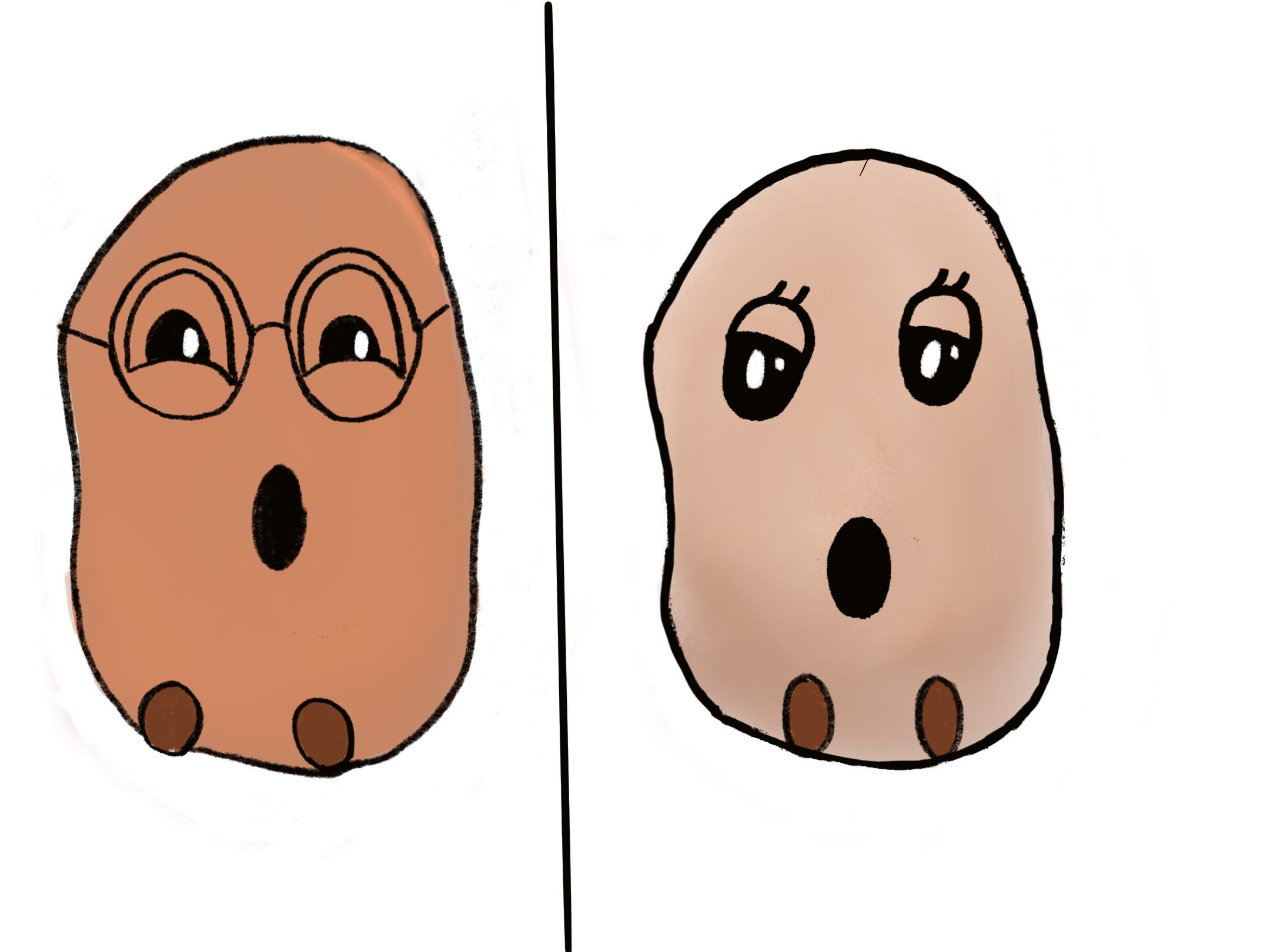
Wintry, unspectacular potato looks back perplexedly at its past framed face.

Outside of a few trials and tribulations with lenses, butties have been a staple diet on my face for 2 decades. I have my LASIK (laser assisted in situ keratomileusis, or one of those words that you’ll know is an acronym but can’t quite place) procedure scheduled for today and I know it isn’t a big deal. I know it is a simple procedure. I know millions of folks have undergone this. I’m not scared (well, I’m not terrified). I’m certainly sentimental though.

– Butti

First few thoughts post-surgery:

  1. My ophthalmologist lied when he called this a painless surgery.
  2. If one eye hurts more than the other, does it mean they botched half the surgery?
  3. Where are my glasses?
  4. My head hurts. On one side. Refer to (2).
  5. I need to remove my lenses/my eyes are dry. (Post surgery, eyes tend to dry out since a part of the procedure cauterizes nerves that connect the cornea to tear glands. This leaves the eyes with a contact-lenses-worn-too-long feeling.)
  6. Whoa, did the window always have so many cracks?
  7. How do people sleep with so much entertainment? One routine I’d created unknowingly was a ‘bedtime mode’ for my vision. Like turning off blue light or setting your phone on B/W mode, removing my glasses made the world dimmer, a bit duller. The world was now too entertaining to just go to sleep. This took a few days to get over.
  8. I can SEEEEEEE! (This I repeated so many times I’m surprised no one has told me off, yet.)

More on eye-related things!

  1. What is Astigmatism, anyway? Here’s a 110 second video with a 60 second explanation.
  2. ‘Starry-Eyed’ can mean you’re an optimist with impracticable thinking. It could also mean that your retina has been detached from the back of the eye by the vitreous fluid and that you need immediate medical attention. As we say it, potato, po-tah-to.
  3. Strawberry Squids, besides having a bizarre name, outdo the rest of us puny species with an asymmetric evolution in vision. The two eyes of the squid are differently sized — one is almost twice as large as the other, and are positioned differently to allow for separate functions. The larger eye is positioned to look up, to sight shadows using the dim sunlight that pervades the depths of the ocean. Sunlight can only permeate up to 200m under the ocean’s surface and Strawberry squids can be found up to 1 km under the surface. The smaller eye on the other side of the head looks down for bioluminescence in the water.
  4. ‘Madras Eye’ or conjunctivitis is an infection to the outermost portion of the eye that can be caused by virus or bacteria. The common name of ‘Madras Eye’ doesn’t seem to have an obvious explanation, apart from a singular pithy article in The Hindu claiming that the virus was first discovered in Madras in 1918. I suppose ‘Madras Eye’ has a better ring to it than ‘Chennai Eye’.
  5. Hindsight is always 20/20 or 6/6? From the 20/20 of visual acuity, the phrase generally means that things are obvious in retrospection that weren’t clear at the onset. I recently found out 20/20 is the same as 6/6 – one’s in imperial units and the latter is in meters. 6/6 means you, at 6 meters away can see what an average person can see at 6 meters. Having a vision of 20/16 would mean you have superior eye-sight, you can see at 20 what the average person can only see from 16 feet away.

Thoughts: The Checklist Manifesto by Atul Gawande

The overall theme can be baked down to a single line: You’re better off with checklists. I wish the author had gone into more concrete arguments about why many fields are slow to cultivate this habit instead of simply diving into examples where it has worked. The fact that checklists work seems intuitive enough to not have to defend it over 150 pages, although the author repeatedly stunned me with the magnitude of improvement in each case and deserves a lot of credit for digging out the data driven results.

My biggest snag with this book is that the author never takes the time to define what exactly a checklist is, and yet devotes 200 pages on anecdotes where it has worked. Everything seems to loosely fit into what a checklist can be and everything from a chef’s recipe to a construction process diagram is categorized as a checklist. Therefore anything that gives a semblance of order is a checklist and everywhere it works or is the lynchpin of a complex system is a success story. With a definition this broad, it’d be surprising if it didn’t work.

I’d have preferred a case for checklists to be made taking into account their drawbacks – the loss of autonomy, culling of creativity (follow this recipe and nothing else), the plain banality and how mind-numbing it is etc. instead of relegating these into a single chapter in the end of the book. The writing is mediocre at best, and reads more like a blogger speaking about a system that brought order to his company instead of a bestselling author devoting as many pages to substantiate an idea. I’d recommend readers to look at some notes and summary for this book and save time (Sam T Davies has a good short post here that suffices, or you can check Graham’s post here for a longer play by play). My take on it – skip the book, read the notes and figure out how you can incorporate it in your day to day – another aspect the author happily skips.

Thoughts: Go Set a Watchman – Harper Lee

There are countless reasons why we love books- some of my favourite times, people, worlds and words are (quite unfortunately, if you think about it) from the fictional pages from books written eons and miles away from me. The most poignant of thoughts, concise of arguments and blatant of truths through my life have been aggregated through books. While that paints a picture of a bibliophile, I should add here that I am a very very regular, sparing reader who’s had a history of bad recommendations being handed over. That’s not the reason I am writing this now, though.

I found love when I read Wodehouse’s character Psmith and felt despair, shock and disbelief as I read through the creative masterpiece that The Book Thief was to me. When I read Harper Lee’s Go Set a Watchman, I found myself.

The protagonist Jean Louise Finch (Scout) is a 26 year old who had stayed blinded to the realities of the world until the course of the book takes over. She had failed to recognize the disparities the color of skin paints upon one, and stayed ignorant of even her close family’s stances and nature. I found myself echoing every emotion she felt- from the tom-boyishness that kicks in harder when she hits ‘womanhood’, to the way she staggers under the weight of the newfound knowledge of living in a world so broken.  I could go on and on about this book, and I am sure I would do exactly that in the coming weeks but for now, I’m going to let Harper Lee’s masterful words take over- in the hope it will get you to pick up the book or start a conversation about it.

“Prejudice, a dirty word, and faith, a clean one, have something in common: they both begin where reason ends.”

““A man can condemn his enemies, but it’s wiser to know them.”

“You said, in effect, ‘I don’t like the way these people do, so I have no time for them.’ You’d better take time for ’em, honey, otherwise you’ll never grow.”

“I thought we were just people. I have no idea”- Scout on race, color and identification.

On accepting a harshly thrown invective, Atticus calmly stands his ground and reasons, “I can take anything anybody calls me so long as it’s not true.”

“I need a watchman to lead me around and declare what he seeth every hour on the hour. I need a watchman to tell me this is what a man says but this is what he means to draw a line down the middle and say here is this justice and there is that justice and make me understand the difference.

I need a watchman to go forth and proclaim to them all that twenty-six years is too long to play a joke on anybody, no matter how funny it is.”

The title, the plot, the character arcs and their personality trait all boils down to one question I have been asking myself since Persepolis. How much of what we are is based on where we come from? And what do you do when where you come from and how you were raised has made you blind?

Go set a Watchman, says Harper Lee.

– Swathi Chandrasekaran

Always on the lookout for book recommendations. If you have some to make or have books to discuss, do let’s connect on Goodreads. Here’s me!


Thoughts: Palestine – Joe Sacco

The last time I cried while reading a book was a decade ago when the final Harry Potter book was released and the words, ‘Here lies Dobby, a Free Elf’ were carved on stone atop a child sized burial mound. Ten years later, I found a work that moved me to tears through a non-fiction that only aims to narrate the staggeringly grim world we live in.

Joe Sacco brings out every little detail in one epic of his work, Palestine: every face, every word and every emotion detailed in the book is so well expressed and so well disguised as a passer by, a passing remark and a motion to be forgotten about. Yet they stay on- haunting the readers, ringing in our ears and singing their despair for us to hear over and over again.

I’d picked up this book a couple of months earlier, intending to finish it. But my lack of knowledge about the Palestine-Israel conflict screamed out to me at every page, every tile. It made me so uncomfortable that I dropped it altogether, deciding that I’d read an Introduction to Palestine- Israel Conflict by Gregory Harms to educate myself first. That… never happened. I read a few pages, skimmed through a few chapters and read up on Wikipedia to satisfy the mood-swings of my curiosity and calm my ignorance induced panic.

I picked this book up again this week and found it to be a work of art that stands easily alongside the titanic shadows of Maus and Persepolis- both books I had thoroughly enjoyed earlier. You don’t need a lot of prior knowledge to venture into this one, the author clearly knows the ignorance of his readers and has handled it here kindly, politely.

The story- if we could call it that- is a loose narration of the events and scenes as experienced by the author in Palestine and they paint a dramatic picture. We notice ourselves (alongside the author) first struggling to accept the pain Palestinians suffer through everyday. Later, just as the author does- we settle to accept it. It still aches, it still pains when an old orphaned mother talks about her son jailed and her daughter-in-law deported, but we’re too broken to feel the crushing blow again. That’s what I felt, exactly mimicking Sacco’s crude character.

By drawing himself to be a story-thirsty, fame-craving journalist, Joe Sacco does us a favour of allowing us to feel like the better human being every now and then. It allows us the cruel, tiny satisfaction of not being as bad, as being the bigger person. This realization hit me only towards the end of the book, and once again I gaped at the intricacy and planning this book would have taken to complete.

There are a few pages and a few panels that I know I will carry with me forever, ones that left an impact I haven’t yet entirely dealt with and I couldn’t help but share just a few here.

A panel that left me as bewildered as the author himself is made, right here:

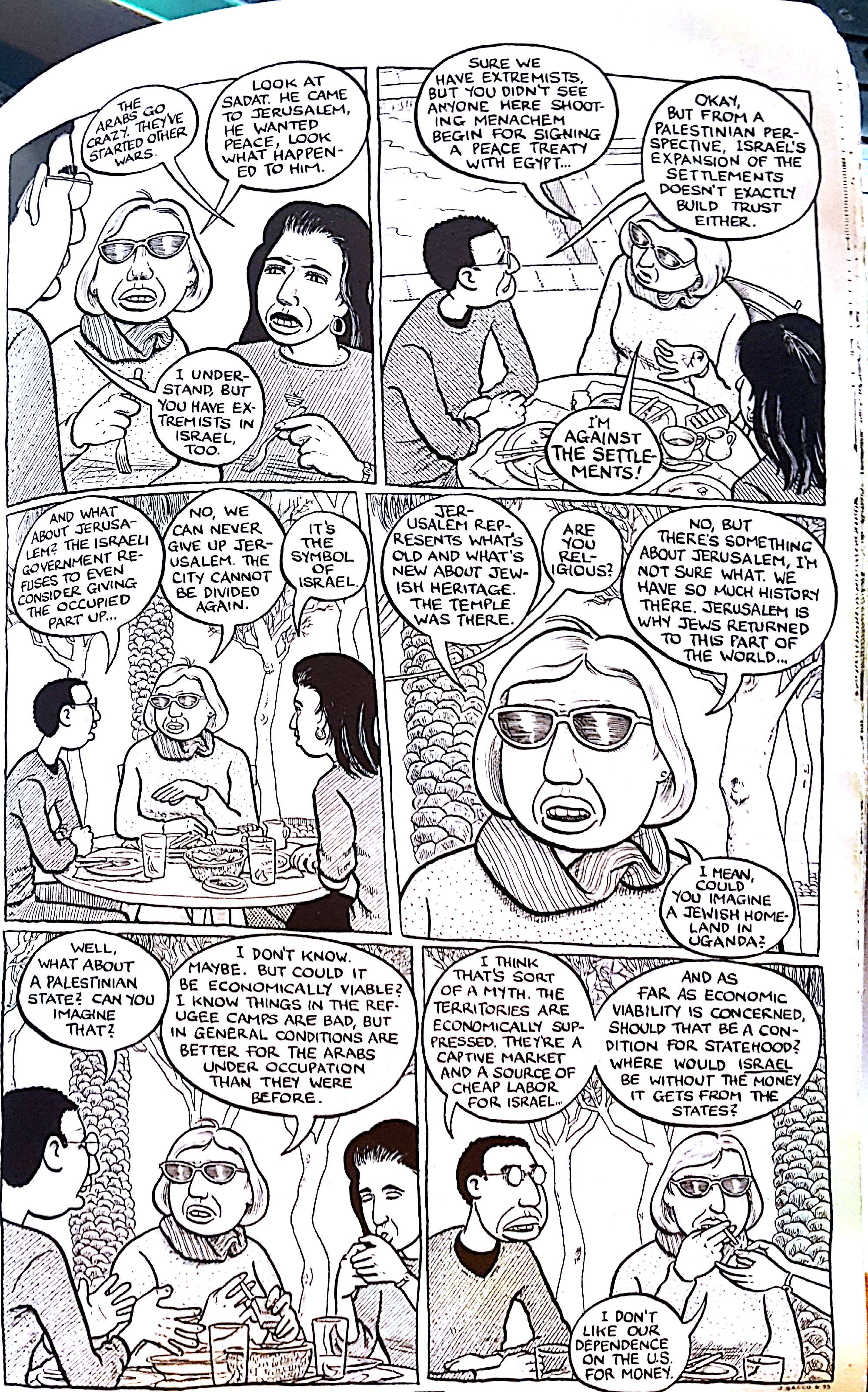
A page that made me panic more about being unaware, and resolve to never relate to the apathy the speaker here boasts from with her all her gloried privilege and unmentioned ignorance.

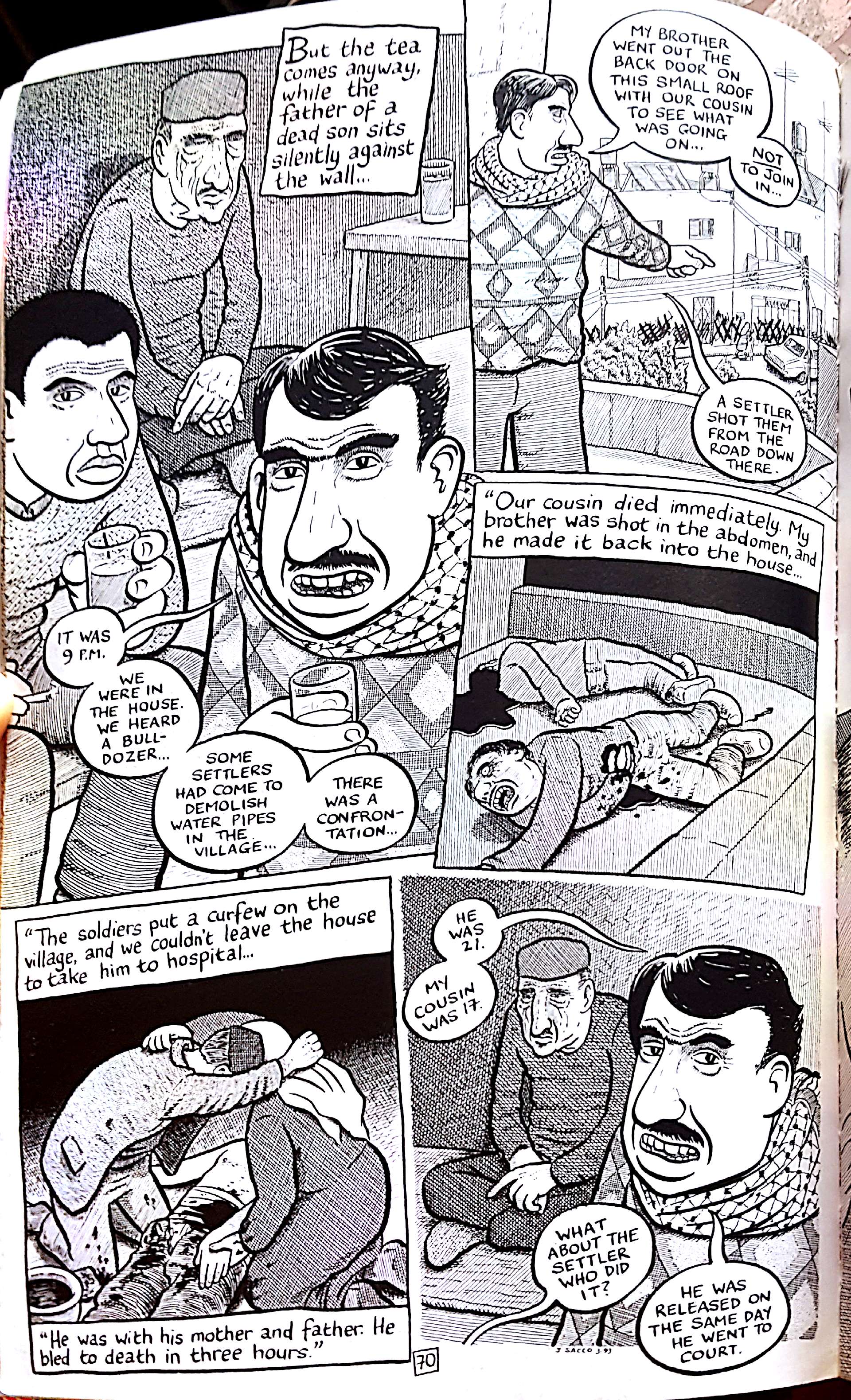
One of the many many pages that took me to the brink of tears.

I would share a lot more but I’d end up stealing from your experience of reading the book if you haven’t already. It is a magnificent, devastating read, and one that I know I’d carry with me forever.

– Swathi Chandrasekaran

Here’s the book on Goodreads

Also- I’m always on the look-out for readers on Goodreads so if you’re on the site and you update regularly please do add me so we can mutually follow each other’s reads. Here’s my profile.