A Good Read: Four Thousand Weeks by Oliver Burkeman

The first thing I’ll say is that the 250-odd paged book is actually a 250-odd paged book. It isn’t an over-elaborated blog post, or a single idea reiterated. I can’t tell you what the “core idea” of this book is. The book is the length it is because it needs to be. Ironically, most productivity books are longer than they need to be, and repeat their core theories over and over. In any case, this isn’t a typical productivity book – it doesn’t have tools to manage to-do-lists, or hacks to drive efficiency metrics.

Four Thousand Weeks. Four Thousand Weeks is the average human lifespan. It’s the same as 75 years, or 28,000 days – and yet, it means something subtly different. 4000 weeks feels smaller than 75 years – we know a year is a long time. It also feels shorter than 28,000 days. 28,000 is too large a number for me to comprehend. A week flies past though, and imagining 4000 of them flying past is easy. And therein, terrifying.

It’s hard to distill this book down to some key learnings – it was a fluid read, with each chapter bringing up concepts that may resonate with the readers in a different way. So instead of trying to boil down the book, I’ll leave some notes that stood out for me. And I’ll hope that it encourages you to pick up this book.

Why You Should Stop Clearing the Decks

…Despite my thinking of myself as the kind of person who got things done, it grew painfully clear that the things I got done most diligently were the unimportant ones, while the important ones got postponed — either forever or until an imminent deadline forced me to complete the, to a mediocre standard and in a stressful rush. The email from my newspaper’s IT department about the importance of regularly changing my password would provoke me to speedy action, though I could have ignored it entirely. Meanwhile, the long message from an old friend now living in New Delhi and research for the major article I’d been planning for months would get ignored, because I told myself that such tasks needed my full focus, which meant waiting until I had a good chunk of free time and fewer small-but-urgent tasks tugging at my attention. And so, instead, like the dutiful and efficient worker I was, I’d put my energy into clearing the decks, cranking through the smaller stuff to get it out of the way–only to discover that doing so took the whole day, the decks filled up again overnight anyway, and that the moment for responding to the New Delhi email or for researching the milestone article never arrived. One can waste years this way, systematically postponing precisely the things one cares about the most.

The Pitfalls of Convenience

Convenience, in other words, makes things easy, but without regard to whether easiness is truly what’s most valuable in any given context. Take those services–on which I’ve relied too much in recent years–that let you design and then remotely mail a birthday card, so you never see or touch the physical item yourself. Better than nothing, perhaps. But sender and recipient both know that it’s a poor substitute for purchasing a card in a shop, writing on it by hand, and then walking to a mailbox to mail it, because contrary to the cliche, it isn’t really the thought that counts, but the effort–which is to say, the inconvenience. When you make the process more convenient, you drain it of its meaning.

Rediscovering Rest

Taking a walk in the countryside, like listening to a favorite song or meeting friends for an evening of conversation, is thus a good example of what the philosopher Kieran Setiya calls an “atelic activity”, meaning that its value isn’t derived from its telos, or ultimate aim. You shouldn’t be aiming to get a walk “done”; nor are you likely to reach a point in life when you’ve accomplished all the walking you were aiming to do. “You can stop doing these things, and you eventually will, but you cannot complete them,” Setiya explains. They have no “outcome whose achievement exhausts them and therefore brings them to an end”.

The Last Time

Sam Harris makes the disturbing observation that our life is a succession of transient experiences, valuable in themselves, which you’ll miss if you’re completely focused on the destination. This applies to everything: our lives, thanks to their finitude, are inevitably full of activities that we’re doing for the very last time. Just as there will be a final occasion on which I pick up my son, there will be a last time that you visit your childhood home, or swim in the ocean or make love, or have a deep conversation with a certain close friend. Yet usually, there’ll be no way to know, in the moment itself, that you’re doing it for the last time. Harris’s point is that we should therefore try to treat every such experience with the reverence we’d show if it were the final instance of it. And indeed there’s a sense in which every moment of life is a “last time”.

So here’s to seeking out atelic activities, relishing in valuable inconveniences, being less hungry to see the bottom of your to-do-list, and cherishing each experience like it could be the last time.
A wonderful read: Dishonesty is the Second-Best Policy by David Mitchell

A book that is quintessentially David Mitchell. For those who haven’t had the fortune of seeing his sharp-wit on various BBC 4 shows, I’d highly recommend any of them. I wish I could go back to discovering his sensibilities once again to relive the joys of hearing his logic for naming children and his proclamations against the murder of grammar and apostrophes.

My recent crush on David Mitchell notwithstanding, this is still a solid book on the current affairs in Britain (where I do not live, but I also do not need to explain to you the reasons I picked this book up). The book itself is a collection of David Mitchell’s essays for The Observer (which, between him and Nick Hornby, has given hours of joyous content to dive into for someone who’s never set foot in England). So the essays themselves were once-upon-a-time topical, now brought to life only by Mitchell’s relentless pursuit of common-sense arguments and the broader scope of some debates.

Here’s an excerpt from the introduction:

Obviously, people have always lied – so we shouldn’t get too excited about our own society, as if it’s done something which, while admittedly bad, is devilishly inventive, like feeding Christians to lions or devising whiskey. Lying is as old as the hills. Older than ones made of landfill, which I suppose are lying about being hills.

Personally, I lie quite often, mainly about whether I am free to attend social events. It’s all because the phrase “I can come but I don’t want to” seems not to be permitted. There’s no way of dressing that sentiment up so that it’s socially acceptable. I’ll have a go, though:

“It’s so kind of you to invite me and I am sincerely grateful for the thought but, on that day, I know I will be tired and would prefer to stay at home, and I very much doubt that you’d really want me to come if I really don’t want to myself, so if it’s OK, I won’t”.

You see? Won’t do. At best you’d get some sort of diagnosis. And you’d hurt the inviter’s feelings. And the inviter would think less of you – that’s the real kicker.

So there’s nothing for it but “Thanks so much — I’d love to come, but sadly I’ve got to [insert lie here].” It’s the only way of availing yourself of your liberty not to attend without breaking social convention. If you believe in freedom and you don’t want people to think you’re a dick – and the vast majority of us fall into this category – you’ve got to lie, and lie well.

It’s a bit crazy really. As a consequence, we live in a world in which ostensibly everyone wants to go to everything they’re invited to. They always want to, but sometimes they just can’t. The notion of people not wanting to go to parties that they’re actually free to attend is not openly acknowledged by our society. It’s like prostitution in the Victorian age: it’s happening everywhere, but everyone pretends it isn’t.

David Mitchell in Dishonesty is the Second-Best Policy

You’d only find such gems if you’re willing to read his writings on Eton students’ visit to Russia, Theresa May’s thoughts on counter-terrorism, rude street names in England and being rich in London. If you’re a lover of David Mitchell’s wit or live in UK, I’d happily recommend this read. If not, perhaps start by watching QI, WILTY, or any of the other BBC 4 panel shows, until you’re in one of the two categories.

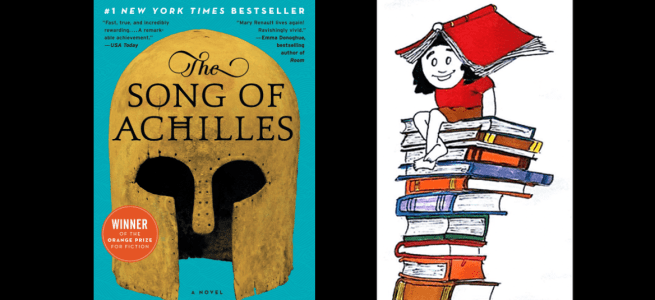
A Wonderful Read: The Song of Achilles by Madeline Miller

My favourite novels are the ones that tread the boundary of prose and poetry – The Circuit, Lord of the Flies, Dalrymple’s Nine Lives, The Book Thief, The Far Field, Miller’s Circe and now, The Song of Achilles. Miller’s acclaimed book on Achilles occupies its space on this precarious boundary easily, rightfully.

The Greek myth is already potent in imagery with its brave, strong humans, Gods of mischief, wars that push the horizons of imagination, magic and madness. In Miller’s skillful retelling, one can hear every wry word uttered by the charmingly crafty Odysseus and witness the golden haired Achilles dancing his lethal dance with his sword.

The art of Miller moves Achilles from the Godly realms of mythology to one who can be cherished and celebrated even more, through the crude humanity of his character. Ironically for a Prince who traded his life for immortal fame to become a Hero, it is his inseparable humanity that defined this read and captured me in it. His young conscience’s hesitations, doubts, helplessness and ego are so relatable that one can empathize with the young Achilles in his poignant moments.

The telling of this poem in Patroclus’ voice was a choice of genius. Who better to retell this tale of heroism than the utterly average mortal companion that Achilles chose? Achilles, who had all the young men line up in the hopes of being chosen as his trusted counsel instead picks Patroclus – a scrawny orphaned nobody who is defenseless in wars of both swords and words. And it is in this trusted counsel that Achilles finds himself to be more than the prophecy of a hero. For Patroclus sees Achilles as human first, and in turn, Achilles is grounded in the essence of being mortal.

And thus Miller transforms Achilles from just another Greek mythology’s war statistic (poor Heracles, Hector, Philoctetes, Ajax and innumerable others) to a hero in all his imperfections, immortalizing him in his humanity. I for one, grieved more for this Achilles’s expected demise than for Achilles the God or Achilles the Hero’s.

I’d recommend this book without hesitation to anyone looking for a fast paced work of fiction that can move you to a different world with Miller’s melodic writing and unforgettable characters. And I can’t wait for her next epic.

– Swathi Chandrasekaran

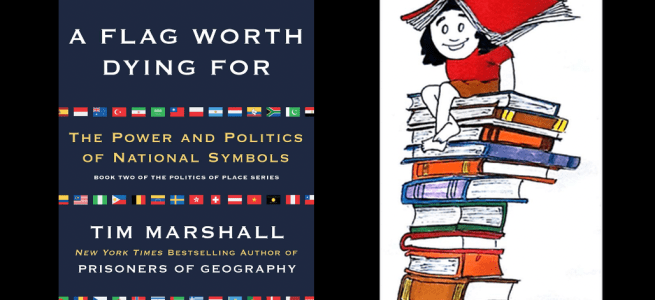
A Good Read: A Flag Worth Dying For by Tim Marshall

A book filled with intelligent trivia that’s tainted by the author’s commentary. Even for a geo-politics newbie like me, Marshall’s biases were impossible to ignore. Perhaps if you avoid the ‘Flags of Terror’ chapter and the author’s relentless obeisance to the United States, the book would make for a spectacular read. It’s a treasure trove of the histories of nation’s flags written in a highly capable journalist’s immaculate way of stitching the world together. Unfortunately, those biases do exist, and the Flags of Terror chapter is a central part of the book, both of which fell uncomfortably on my boundaries of bearability.

I’ve had my fair share of obsession with flags of the world, and questions like “Why are the Mexican and Italian flags so similar” have certainly entertained me. So this book was fantastic – at the least, it informed me on which questions were worth pondering more on and which of them were truly inconsequential (The Mexican-Italian coincidence, for instance.) The optimistic chapter on Central and South American flags (Flags of Freedom) and the chapter that quickly and efficiently analyzed the African flags were some of the high points of the read.

If the narration hadn’t so obviously been affected by Marshall’s political views, this book would have been an instant recommendation from me. As it stands, I’ll add the disclaimer and assert that it’s still worth a read. However, I’d recommend one to read Prisoners of Geography first, Marshall’s more recent release which, while still being opinionated, is more reasonably so.

– Swathi Chandrasekaran

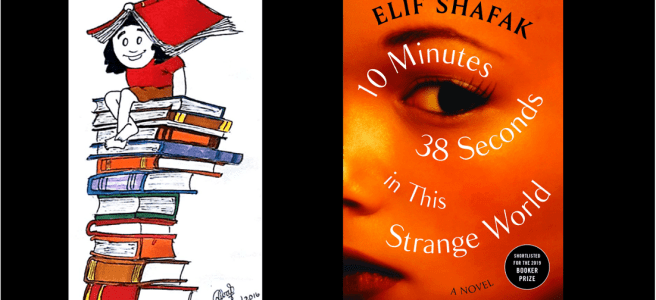
Disappointment: 10 Minutes 38 Seconds in This Strange World by Elif Shafak

I’ll start by saying I had no preconceived notions about this read before I picked it up. The only information I had on the book were from the blurb and cover, having received it as a gift from a friend. My disappointment therefore, stems entirely from the beauty of the initial parts of the book and the colossal carnage of the characters and plot that followed in later parts.

The author takes care to set out a detailed and exact representation of the world through part one, as she narrates the world through Leila’s eyes. The world is flawed, and the flaws exist for no rhyme or reason. The author explores this idea over and over again, through the numerous sufferings of her protagonist Leila – a woman abused in her childhood and exploited in Istanbul as she strives to create a life for herself. So real are the incidents in part one that the futility of hope and random allocation of privilege, luck and chance shine even when the protagonist is on the receiving end of such niceties. Leila is one of the lucky few to escape an acid throw with only a gash on her back, and is blessed with a regular marital life after being a whore at an Istanbul brothel for years. Even in the narration of these chance events for example, Elif takes time to note the jealously of Leila’s fellow prostitutes, showing that what Leila got was simply another unfair dose of luck that benefitted her instead of someone else this time. Part one is filled with such events which are deeply rooted in reality, each of which made me deliberate on this unfair life we lead.

Hence the sharp transition of part two into a Wodehousian affair led by Leila’s close friends (whose only similarity seems to be their eccentricity) shocked, infuriated and disappointed me as a reader. The five friends of Leila, once so beautifully described through Leila’s thoughts now were skeletons of characters, each easily explained by one adjective – the devout, the cowardly, the loyal, the sick and the other (who didn’t even matter in the end.) The characters take some insane decisions that would never pan out, and go about enacting it through painful chapters that read like a young-adult fiction with a diverse set of characters. It made the beautiful characters from chapter one seem like they were only there for a diversity quota.

Part three of the book speaks about the soul of Leila, now demised. This is so antithetical to every open ended question in the book on the existence of souls and whether they were only religious constructs.

A book with amazing promise and a sharp let-down. I highly recommend that you skip this book unless you want to experience investing in a disappointment.

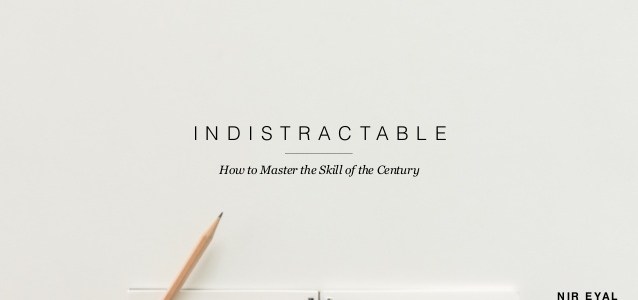
Thoughts: Indistractable by Nir Eyal

timebox.png

The first key point I should mention here is Nir Eyal’s emphasis on time-boxing as a valuable technique in productivity. Simply having checklists and to-dos elongating each day will not do the trick for productivity if we are not mindful of the pace at which we work or the time we have in a day to complete those tasks. Another technique I have found pretty useful is prioritizing work and picking up as many as possible in a day, but of course that becomes harder when we have work with deadlines in the mix with passion projects and time taken to relax. Eyal’s solution of time-boxing takes this into consideration, which I think is a valuable mention. Here’s another great article on time-boxing that I found useful.

“The people we love most should not be content getting whatever time is left over. Everyone benefits when we hold time on our schedule to live up to our values and do our share”.

family.png

Not scheduling time for our family and close friends while we schedule the rest of our week will certainly lead to disaster. Personally, I’ve found that I tend to forfeit the video calls with my parents when burdened with assignments and that I almost always reach friends’ gatherings later than I intend to because of other work that needed my attention. It makes so much more sense to schedule your day including time for your relationships, so that you’re not choosing between good sleep or talking with your boyfriend at the end of a long day.

“We implemented a 10 minute rule and promised that if we really wanted to use a device in the evening, we would wait 10 minutes before doing so.”

For me, this simple rule was eye-opening in its results, decreasing temptations to unlock my phone for absolutely nothing, spending minutes re-reading headlines I’d already looked at, opening up Whatsapp to check if I had any new messages (when my notifications are turned off), or re-checking and re-reading emails. Setting this small time requirement before unlocking phones when studying or when you’re out with friends might just create the difference between productivity and time helplessly lost surfing the unlimited web.

“Phubbing, a portmanteau of phone and snubbing means to ignore when in a social situation by busying oneself with a phone or other mobile device.”

I’m sure you’ve done this, as have I. I’m also certain you’ve been annoyed at your friends doing this around you. For me, this was a reminder to stop.

“Schedule time for yourself first: By time-boxing ‘you’ time and faithfully following through we keep promises we make to ourselves.”

original.jpeg

Just as we set aside time for relationships, it becomes obvious that we need to do the same for ourselves, demanding time taken from our schedule to see how we are coping up with the week or the month. Taking this time means we get to slow down and reassess our goals – that we have the possibility of changing and restructuring our week if we have to. For me, a weekly time off to look at my schedule made sense, a time for me to rewrite the goals for the week if needed or push myself more when necessitated.

– Swathi Chandrasekaran

Once again, here’s me on Goodreads! Say hi, drop book recommendations and let’s connect over more reads.

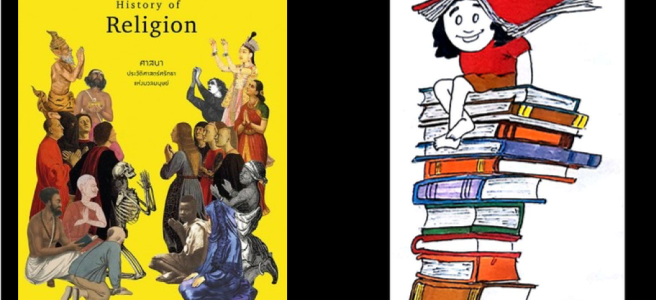
A Wonderful Read: A Little History of Religion by Richard Holloway

Through my childhood, I’ve had the pleasure and discomfort of sitting through innumerable rituals at home, religiously uttering words that made no sense to me, partaking in every festivity until they became routine to me. The way my legs would cramp up after a few hours of sitting cross legged on the floor, the pangs of hunger we’d feel as we waited for the rituals to get over so we can eat, and what now I think of as the most curious ritual I’ve performed – placing carefully cooked and colored balls of rice on our terrace for our unfriendly neighborhood crows while praying that all the best things happen to the men in the family. We also had rituals where as a ten year old, I was expected to pray and hope for the best husband. Things rarely made sense then.

I’m sure you have some stories of your own. I’m not saying that this book explains why that particular notion started, why I would be woken up at 6 to feed the cawing crows that I was terrified of, but it definitely to me lent a different way of looking at religion. A way of putting things into perspective for the bad and the good. Everything my parents said, and my grandparents spoke about is there in that one chapter of Hinduism but it made so much more sense reading it now and being able to think about the chronology (the supposed one, in some cases).

The author’s writing style is straight-forward, seasoned with some lines of wry humor every now and then. His utter devotion to rationality in arguments is what won me over, and his presentation of multiple sides of the delicate topic for me came through wonderfully (but to begin with, I was and am atheist, perhaps that affected my capacity to tolerate his commentary). The one thing I’d wish for was that more was said about eastern religions, although what was said already held a high potency and helped me understand religion a little better.

Here are two beautiful quotes from the book I’ll leave you with:

Religion’s preoccupation with life after death so often made it an enemy of life before death.

Religion can be a drug that soothes the pain of existence. Only an ungenerous mind would fail to sympathise with those whose misery is eased in this way.

I hope you see the beauty in these words the way I did. If you do, you should reach out and grab a copy of A Little History of Religion as soon as you can. Happy reading!

– Swathi Chandrasekaran

If you want to see more such reviews, connect with me here on Goodreads!

Critique: Letter to my Daughter by Maya Angelou

Until I read over 50 pages of the book, I didn’t realize what was so uncomfortable about the read. There was something off-putting about the book I couldn’t get my finger on and forced me to read more and research more about the book. Maya Angelou was 81 years old when this book was published. That’s 81 years of wisdom she is trying to impart to her readers, which is a good idea. Unfortunately, the book reads like 150 pages of preaching, of someone lecturing me on the rights and the wrongs with an insufferable tone of; having gone through it all’ and knowing it all. I’m certain these stories could still be looked at for inspiration from someone who has seen more of the world than I have but the tone and communication of it leave much to be desired. I also noticed the innumerable ‘humble brags’ littered around the book in completely unnecessary places, and perhaps that added to the fire. Here are the opening lines of three such opening lines in chapters:

“Many years have passed since the American Film Institute gave a tribute to William Wyler, one of Hollywood’s most prolific and prestigious directors. I, as a member of the Board of Trustees, was asked to participate in the ceremony… Of course I was flattered by the invitation and I accepted.”

“Recently I had an appointment with four television producers who wanted my permission to produce a short story I had written.”

“In the early seventies I was invited to speak at Wake Forest University in Winston-Salem…”

I’m not sure about you, but for me this read was quite intolerable and I was glad for the short text.

Ever since I read Hornyby’s Polysyllabic Spree I’ve tried to stay away from reads I didn’t enjoy, but this one was short and I had to figure out everything I despised about it and rationalize my hatred. I would strongly encourage you to stay away from this read if you have anything else on your read list. This one might be worth the least of them all.

– Swathi Chandrasekaran
Find me here on Goodreads.

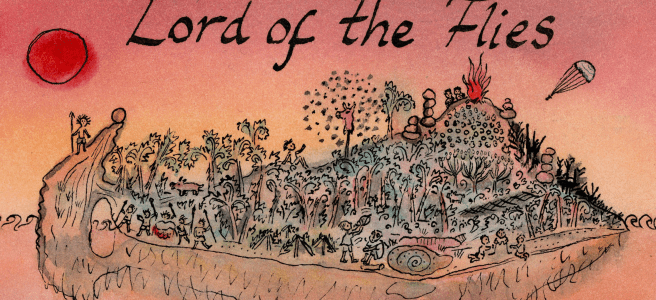
Lord of the Flies by William Golding

A book from all the way back in 1954 that struck my heart red hot today as I trembled and shook, turning the pages in absolute fear, completing this read.

This book brought me to tears and it took me a while to bring myself back to reality. What starts out by being a rather playful narrative of kids lost on an island awaiting rescue takes a number of dark turns, and one of them struck awfully. The incidents escalated to their tremendously dark end, and the I felt myself breathe in panic alongside the characters as I ran, wept, hurt and hid in my fears. I wish the characters had been made more relatable through a scale of grayness instead of making them the very extremes of their traits, but that was a creative decision that still did work and hurt me enough to bring me to my knees internally as I begged for mercy from the pain that haunts the book through eerie events and troubling reality. I do agree with a number of other reviewers that some of the author’s decisions made it easier for me to extract myself from the pages, and it wasn’t as troubling or real as it could have been – but what it was by itself is quite a potent shock and I felt myself walking the world of Ralph and Jack as I turned the pages and finished the book in one sitting.

– Swathi Chandrasekaran

Lover of books and on the look out for books that made you linger on the pages, thoughts or troubles of worlds far away, unreal or terrifying. Find me here on Goodreads and let’s talk more books!

How to Be Happy- Eleanor Davis

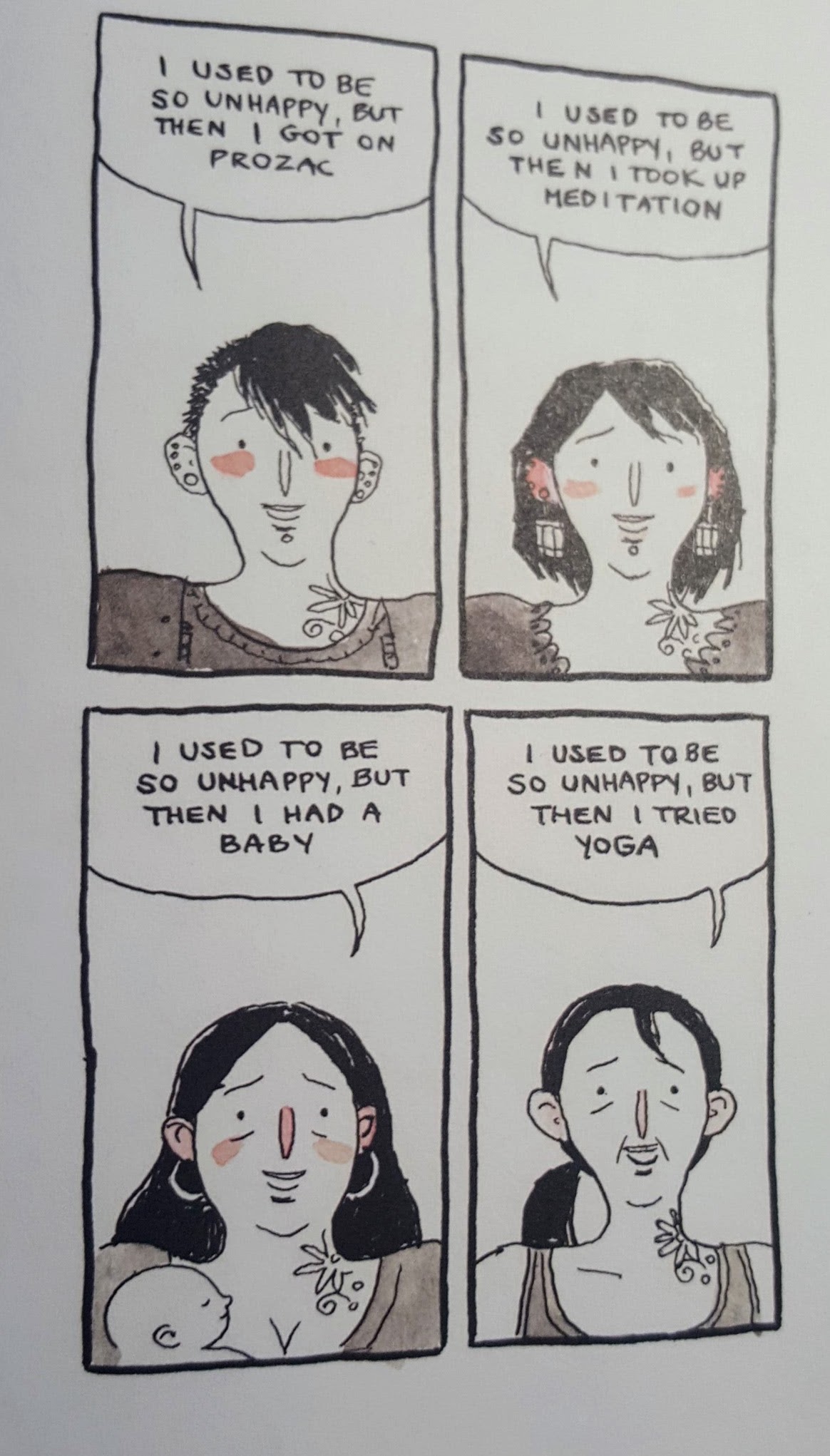
‘How to Be Happy’ is a collection of graphic short stories that speaks about the disillusioned beliefs of happiness we glorify today with just the right amount of abstractness to take away the author’s obviously cynical stance. The book hence ironically talks about how not to be happy instead, spewing sarcasm while speaking through the voice of the society’s happy and blessed.

Aim: Being Happy
Societal Procedure: 

20181025_133228.jpgEleanor Davis in How to Be Happy. 

I put off writing this short piece long enough to let it simmer in the back of my head, because of the sheer difficulty I had in comprehending a number of these panels and pieces in the book. It is an abstract piece of graphic novel, and the first one of its genre for me. I thoroughly enjoyed a few panels, and with some I felt myself sink into depths of cynicism as to what it could possibly represent.

20181025_133235.jpg                                                        On grief in How To Be Happy.

In all, a book I would recommend for exactly three distinctive, deep pieces that I felt resonate with me and if you read this book and find yourself connecting to something else I’ll understand that the book is as abstract and captivating as intended to be by the author.

An extremely short read I’d propose best suited for a lazy reader’s bedtime story or a quick break between work. A few of these panels have the capacity to strike iron red-hot, or go completely unnoticed depending on your moodiness. Perhaps that’s what makes the book as complicatedly abstract as I found it!

If you’re intrigued, here’s a short interview with the author Eleanor Davis on the book. This is a book I’d suggest if you’re interested in venturing into an unfound genre and decrypting the possibly profound messages, but if that’s not what you’re looking for- maybe it’s best you stay wary of How to Be Happy.

– Swathi Chandrasekaran
Book lover with constrained hours for reading on the lookout for recommendations- feel free to find me here on Goodreads and share your thoughts!