Where’s that?

Faroe Islands: Not spelt Farrow, but can be spelt Faeroe instead. The official language is Faroese. They’ve been inhabited since the 4th century, and settled/ruled/owned by Norwegians, English, Danes, Icelandic. If we were to enforce a narrowly won referendum from 1946, Faroe Islands would be an independent state, but that was annulled by the King of Denmark, and so the islands belong to (surprise, surprise!) the Danish Kingdom. Sorry, where is this archipelago, you ask? Midway between Iceland, Norway and the UK in the Atlantic Ocean.

Christmas Island: Closer to Indonesia than to Australia which governs the land, Christmas Island hovers just about 350 km south of the Java Islands. It was named so because of its discovery on Christmas Day in 1643 by an English sea captain with an allegiance to the East India Company. The British lost the island to the Japanese during World War II but eventually reclaimed it. And later, the British Colony of Singapore sold Christmas Island to Australia for $20 Million in 1946 for its Phosphate mines. English, Malay, Mandarin, Cantonese, and Hokkien are the primary spoken languages, and the island boasts of a population of under 2000 people. Christmas Island is known for a natural world’s phenomenon as well, but more on that later.

Cocos (Keeling) Islands: I’m cheating a little bit by picking this next, since it shares most of its history with Christmas Island. Further south of Indonesia (and still nowhere close to Australia), Cocos Islands were also purchased by Australia from the British Singapore in 1955. The island was discovered by William Keeling in 1605, but not inhabited until a certain John Clunies-Ross stopped by 200 years later, planted the flag of the Union Jack, and left with the notion of bringing his wife and family to settle in these islands. Before he could do that though, another wealthy Englishman Alexandre Hare, had the same idea. Except, instead of bringing his family, Hare brought in Malay women to create a ‘voluntary’ harem and settled in the islands. When John Clunies-Ross arrived with his family and some soldiers, a feud grew between the two Brits, with John ultimately winning the islands from a distraught Alexandre whose ‘wives’ had run away or left him for the newly-landed soldiers. John then took over administration of the islands, and even minted his own currency, the Cocos Rupee.
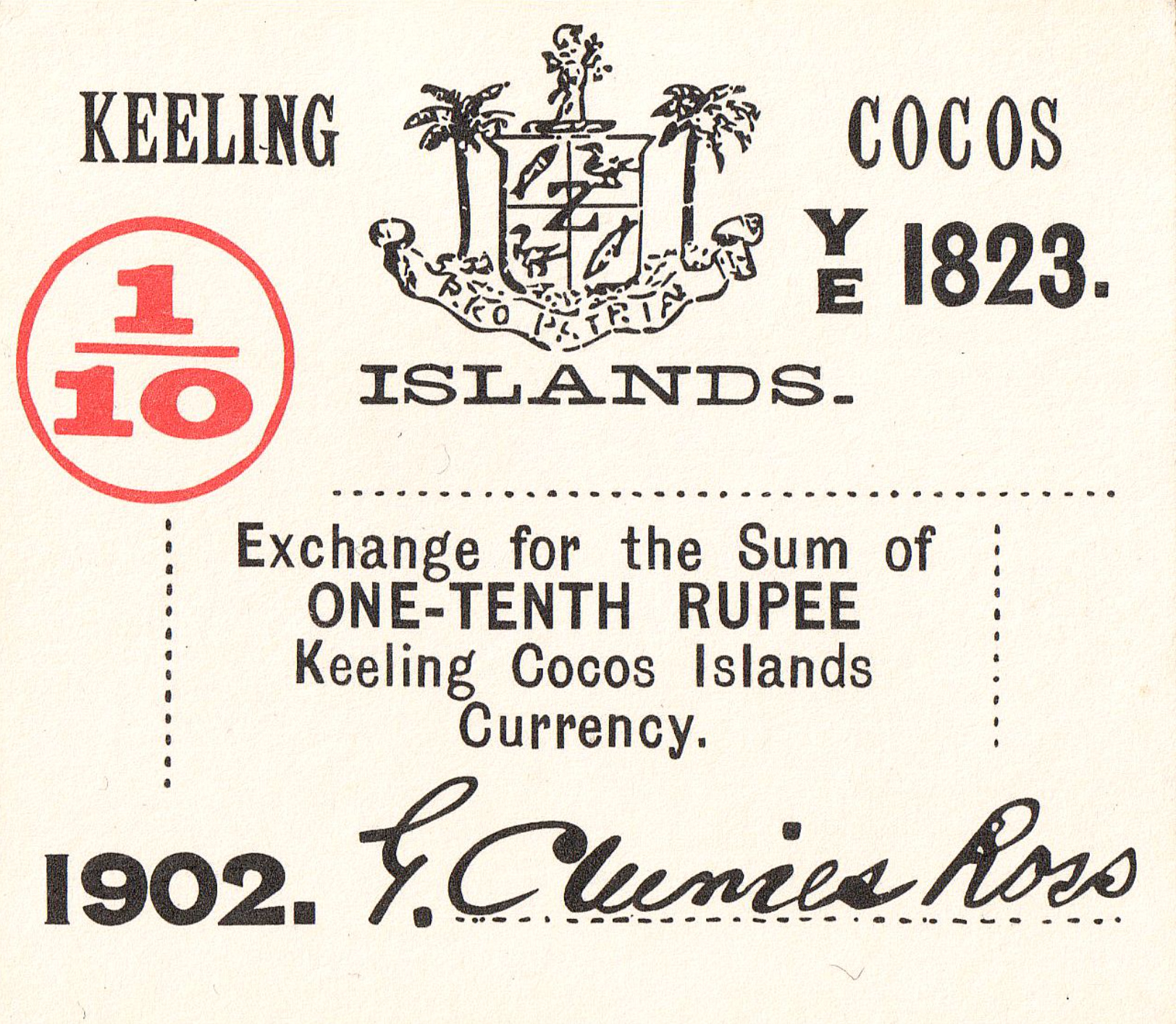
The Brits officially controlled the islands from 1906, even though all the land belonged to John. These islands have a fascinating history in both the world wars, owing to a telegraph station the Brits built here, on an island that they helpfully called ‘Direction Island’. Today, the islanders (all 600 of them) predominantly practice Sunni Islam, and speak Malay. The islands are named so after their abundance of coconut trees.

Related, and absolutely fascinating: The annual red crab migration of Christmas Island occurs around October/November each year, and sees an estimated 40 million red crabs coolly walking, climbing and shimmying across the island to get to the ocean in order to breed. The male crabs start earlier, leaving their homes in the jungle to reach areas around the ocean where they create burrows and wait for their potential female mates. The females arrive fashionably late, and spend an additional couple of weeks incubating the eggs and making a further trip to the ocean to finally release the larvae into the water. Whales migrate to the coast of Christmas Island to feast on the newly released larvae. The baby crabs that survive all this then make the treacherous journey back to the jungles in the middle of the island. Here’s a video of all this chaos.

Things I learnt from this video:

  1. There are crab infrastructures created in Christmas Island each year: this includes crab bridges, detours, and underpasses.
  2. Crabs are cannibals. They feed on the ones that don’t make it to the ocean.
  3. Crabs can climb over absolutely anything.
  4. A female red crab can release up-to 100,000 eggs at once.
  5. Christmas Islanders are alarmingly calm about red crabs.

Here’s a bonus article featuring a video by David Attenborough on the same migration.
Perplexed Potato still can’t figure out where that is.

The problem with labels in arguments

A high school physics teacher once enforced a rule in his classes which still stands out to me as the single best method in learning — ‘You’re only allowed to use a new word once it’s been defined and everyone agrees on its meaning’.

What did this look like in practice? When learning about objects moving at a constant speed, for example, we weren’t allowed to use terms like forceacceleration, or gravity. If we wanted to introduce a new word, we had two choices: take the time to define it for the class, or stick to concepts we’d already established.

That same principle of establishing shared understanding before using a term feels increasingly rare in social discourse.

During conversations about policies, politics, and beliefs, I’ve often heard someone in the group make a quip along the lines of, “That is an X argument” where the X could be ‘communist’, ‘conservative’, ‘sexist’, or the like. It seems intelligent in its premise: someone is able to summarize a nuanced and lengthy argument into a single, succinct label.

Sometimes however, the single, succinct label ‘X’ is used to discredit someone’s nuanced argument. Instead of moving the discussion forward, it’s weaponized to attack the speaker and discredit their argument quickly. Too quickly. Now, the burden of proof shifts: the speaker must defend herself against the label, rather than have her original argument considered on its own merits. And because labels come preloaded with assumptions and baggage, choosing not to reject the label can imply tacit acceptance of everything that comes with it.

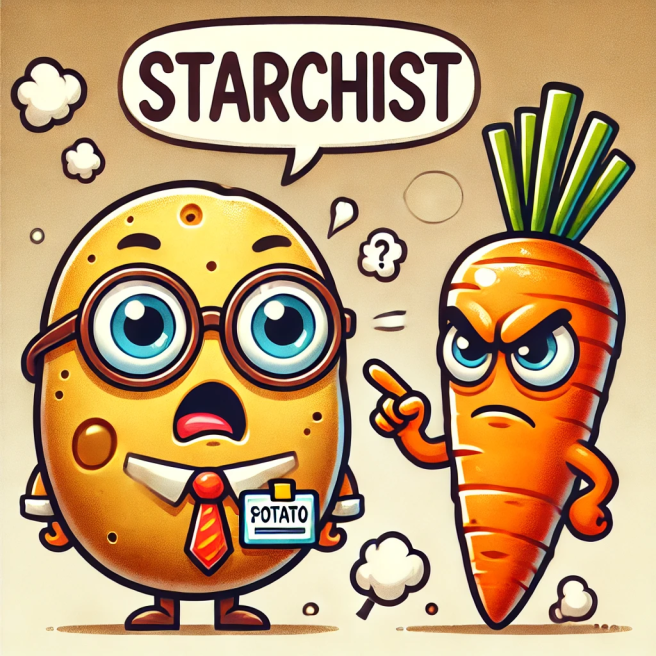
Potato stunned by carrot’s labeling

Scott Alexander calls this the Non-Central Fallacy—when a label technically applies to something but leads us to reject it based on extreme or unrelated associations. His article shows someone dismissing a scientific concept as “sexist,” not because it devalues women, but because it talks about sex differences at all. The word might technically apply, but it’s doing more to stop the conversation than to clarify it.

″Evolutionary psychology is sexist!” If you define “sexist” as “believing in some kind of difference between the sexes”, this is true of at least some evo psych. For example, Bateman’s Principle states that in species where females invest more energy in producing offspring, mating behavior will involve males pursuing females; this posits a natural psychological difference between the sexes. “Right, so you admit it’s sexist!” “And why exactly is sexism bad?” “Because sexism claims that men are better than women and that women should have fewer rights!” “Does Bateman’s principle claim that men are better than women, or that women should have fewer rights?” “Well…not really.” “Then what’s wrong with it?” “It’s sexist!”

So what can I do about it? The next time a label gets thrown into a conversation in an attack, this is a note to myself to pause, turn around, and ask the label-lover to define it.

“What do you mean by X?” or “Why do you think this is X?”

Maybe that way, the onus of defense goes back to the wielder of labels, and we can open the door to more meaningful dialogue with respect, nuance, and shared understanding.

And About That: Happy New Year or Happy new year?

Resolutions are for people who have flaws and fallibilities, never mind the rest of us

It’s that time of the year again!

Like our calendar, our resolutions also have European roots. January, derived from the name of a Roman God Janus, represents the month when Romans would promise the God to be on their best behaviour, which back then was displayed by paying their debts and returning ‘borrowed’ objects. Janus is one of Rome’s rare own Gods, with no counterpart in Greece. Depicted as the god of transition, Janus is imagined to have two faces – one looking back at history, and the other facing forward, into the realms of future. (Given such mythological powers, which direction would you look?)

On that note, here are some of our inspirations for setting resolutions for the year!

On setting atomic goals, from Veritasium.

And on setting supersized themes instead, from CGP Grey(Clearly I couldn’t make up my mind on which one works better and chose the lazy way out by leaving the readers to decide).

Whatever your resolutions are, one recommendation from us is to have regular check-ins to see how you’re tracking and adjust the goals accordingly. This app has worked well for half of us who’ve tried it.

How do you plan to send wishes for the new year? What do the wishes mean grammatically, and behaviorally (I think):

  1. Happy New Year!
    • Only valid for Jan 1, or a few weeks in January for the perpetually tardy.
  2. Happy new year!
    • The more generous wish – here’s to wishing 364 times more fun than the folks above.
  3. Happy New Year’s!
    • New Year’s what?
  4. Happy New Years!
    • Talk about being generous! They’re wishing a wonderful rest of your life (whether that means they never intend to ever meet you again, we don’t know).
  5. Happy 2023!
    • We see what you did there. Smart.
  6. I don’t partake in such trivialities of humankind. I’ll abstain.

And about that…Coriander/Cilantro

This flavorful green has a longer history than its unassuming nature showcases. We’ve found evidence of coriander use six to eight thousand years ago in Israel, and the question of where it originated and was first put to use is still unanswered. The range of that answer covers all the way from Portugal to Israel, approximately 4000 kms in distance.

Interestingly, while the taste of these leaves is typically described as lemony/tart-like, one in four people instead describe them as ‘soap-like’. Odd as it seems, this is linked to a gene that detects aldehydes (that chemical term we learnt in high-school) in coriander which are also incidentally used in soaps and odorants.

Coriander seems to have always had a problem with hiding its body odour. The very name coriander derives from koríannon (Ancient Greek) which is related to kóris, the term for a bed-bug in Greek. The Spanish name cilantro also derives from coriandrum, and is the more common American term for this plant owing to its large use in Mexican cuisine.

Turns out that before we linked the smell of coriander to the cleansing smell of dish-soap, it was already linked to the smell of bed-bugs, and hence earned its name. The 1 in 4 people aren’t the ones who seem like weirdos anymore, huh?

Potato holding a sprig of coriander and wondering why