Thoughts: Go Set a Watchman – Harper Lee

There are countless reasons why we love books- some of my favourite times, people, worlds and words are (quite unfortunately, if you think about it) from the fictional pages from books written eons and miles away from me. The most poignant of thoughts, concise of arguments and blatant of truths through my life have been aggregated through books. While that paints a picture of a bibliophile, I should add here that I am a very very regular, sparing reader who’s had a history of bad recommendations being handed over. That’s not the reason I am writing this now, though.

I found love when I read Wodehouse’s character Psmith and felt despair, shock and disbelief as I read through the creative masterpiece that The Book Thief was to me. When I read Harper Lee’s Go Set a Watchman, I found myself.

The protagonist Jean Louise Finch (Scout) is a 26 year old who had stayed blinded to the realities of the world until the course of the book takes over. She had failed to recognize the disparities the color of skin paints upon one, and stayed ignorant of even her close family’s stances and nature. I found myself echoing every emotion she felt- from the tom-boyishness that kicks in harder when she hits ‘womanhood’, to the way she staggers under the weight of the newfound knowledge of living in a world so broken.  I could go on and on about this book, and I am sure I would do exactly that in the coming weeks but for now, I’m going to let Harper Lee’s masterful words take over- in the hope it will get you to pick up the book or start a conversation about it.

“Prejudice, a dirty word, and faith, a clean one, have something in common: they both begin where reason ends.”

““A man can condemn his enemies, but it’s wiser to know them.”

“You said, in effect, ‘I don’t like the way these people do, so I have no time for them.’ You’d better take time for ’em, honey, otherwise you’ll never grow.”

“I thought we were just people. I have no idea”- Scout on race, color and identification.

On accepting a harshly thrown invective, Atticus calmly stands his ground and reasons, “I can take anything anybody calls me so long as it’s not true.”

“I need a watchman to lead me around and declare what he seeth every hour on the hour. I need a watchman to tell me this is what a man says but this is what he means to draw a line down the middle and say here is this justice and there is that justice and make me understand the difference.

I need a watchman to go forth and proclaim to them all that twenty-six years is too long to play a joke on anybody, no matter how funny it is.”

The title, the plot, the character arcs and their personality trait all boils down to one question I have been asking myself since Persepolis. How much of what we are is based on where we come from? And what do you do when where you come from and how you were raised has made you blind?

Go set a Watchman, says Harper Lee.

– Swathi Chandrasekaran

Always on the lookout for book recommendations. If you have some to make or have books to discuss, do let’s connect on Goodreads. Here’s me!
 

Thoughts: Palestine – Joe Sacco

The last time I cried while reading a book was a decade ago when the final Harry Potter book was released and the words, ‘Here lies Dobby, a Free Elf’ were carved on stone atop a child sized burial mound. Ten years later, I found a work that moved me to tears through a non-fiction that only aims to narrate the staggeringly grim world we live in.

Joe Sacco brings out every little detail in one epic of his work, Palestine: every face, every word and every emotion detailed in the book is so well expressed and so well disguised as a passer by, a passing remark and a motion to be forgotten about. Yet they stay on- haunting the readers, ringing in our ears and singing their despair for us to hear over and over again.

I’d picked up this book a couple of months earlier, intending to finish it. But my lack of knowledge about the Palestine-Israel conflict screamed out to me at every page, every tile. It made me so uncomfortable that I dropped it altogether, deciding that I’d read an Introduction to Palestine- Israel Conflict by Gregory Harms to educate myself first. That… never happened. I read a few pages, skimmed through a few chapters and read up on Wikipedia to satisfy the mood-swings of my curiosity and calm my ignorance induced panic.

I picked this book up again this week and found it to be a work of art that stands easily alongside the titanic shadows of Maus and Persepolis- both books I had thoroughly enjoyed earlier. You don’t need a lot of prior knowledge to venture into this one, the author clearly knows the ignorance of his readers and has handled it here kindly, politely.

The story- if we could call it that- is a loose narration of the events and scenes as experienced by the author in Palestine and they paint a dramatic picture. We notice ourselves (alongside the author) first struggling to accept the pain Palestinians suffer through everyday. Later, just as the author does- we settle to accept it. It still aches, it still pains when an old orphaned mother talks about her son jailed and her daughter-in-law deported, but we’re too broken to feel the crushing blow again. That’s what I felt, exactly mimicking Sacco’s crude character.

By drawing himself to be a story-thirsty, fame-craving journalist, Joe Sacco does us a favour of allowing us to feel like the better human being every now and then. It allows us the cruel, tiny satisfaction of not being as bad, as being the bigger person. This realization hit me only towards the end of the book, and once again I gaped at the intricacy and planning this book would have taken to complete.

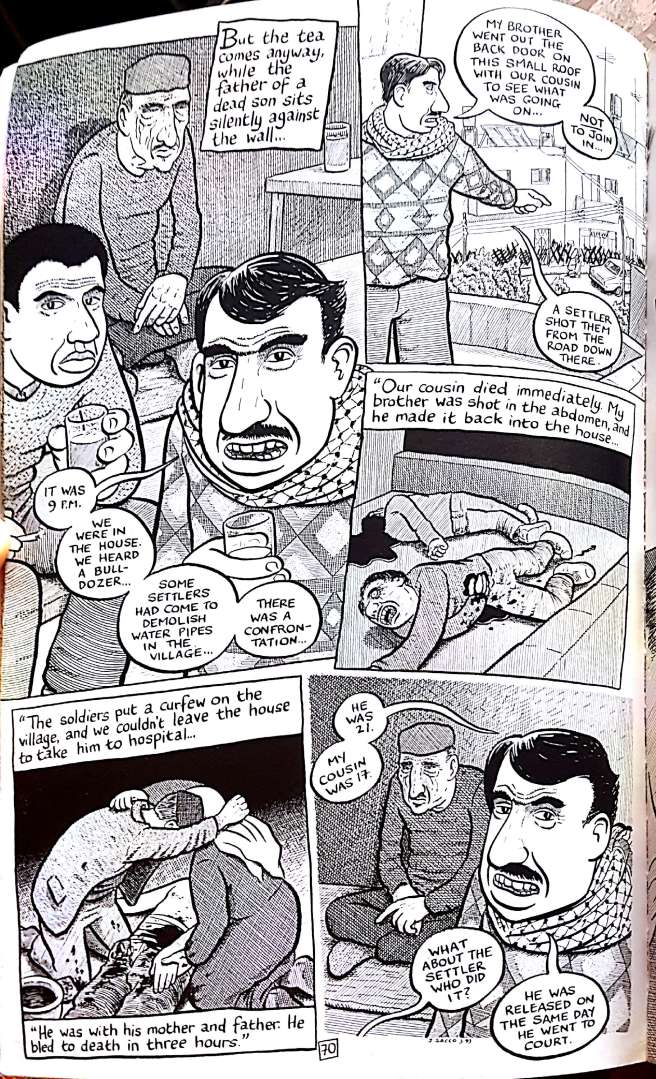
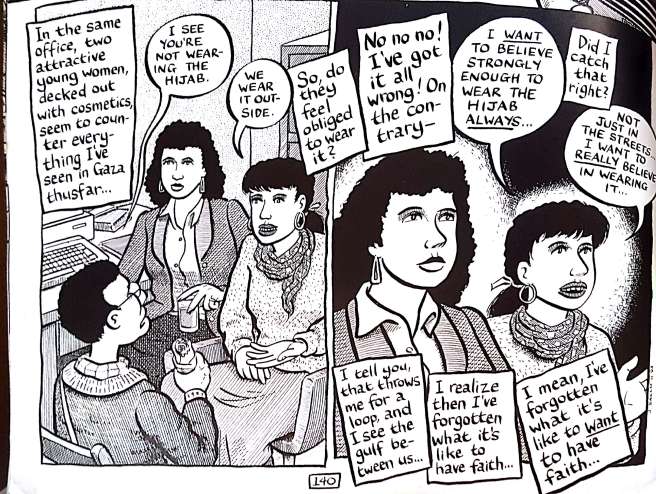
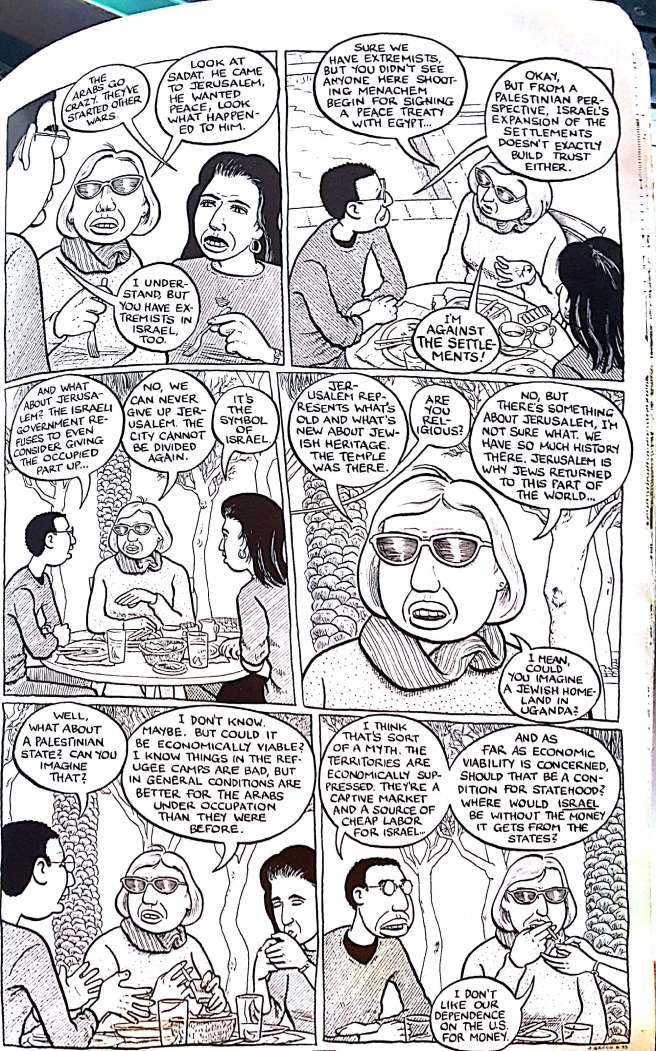
There are a few pages and a few panels that I know I will carry with me forever, ones that left an impact I haven’t yet entirely dealt with and I couldn’t help but share just a few here.

A panel that left me as bewildered as the author himself is made, right here:

A page that made me panic more about being unaware, and resolve to never relate to the apathy the speaker here boasts from with her all her gloried privilege and unmentioned ignorance.

One of the many many pages that took me to the brink of tears.

I would share a lot more but I’d end up stealing from your experience of reading the book if you haven’t already. It is a magnificent, devastating read, and one that I know I’d carry with me forever.

– Swathi Chandrasekaran

Here’s the book on Goodreads

Also- I’m always on the look-out for readers on Goodreads so if you’re on the site and you update regularly please do add me so we can mutually follow each other’s reads. Here’s my profile.

Thoughts: What Do You Care What Other People Think? – Richard Feynman

To me, this book didn’t meet the colossal standards of entertainment and intrigue presented by Surely You’re Joking Mr. Feynman but I read it anyway. It gets quite technical with the descriptions which demanded keen attention I did not possess the patience for while reading but the tone and character of Feynman that I loved through his previous book existed in the lines here as well- albeit in a more serious setting.

One line that resonated strongly with me came up in the very last page of the book:
“If we suppress all discussion, all criticism, proclaiming, “This is the answer, my friend; man is saved!” we will doom humanity for a long time to the chains of authority, confined to the limits of our present imagination.”

What a pithy way to summarise so many evils we have in our society today.

– Swathi Chandrasekaran
Find the book on Goodreads