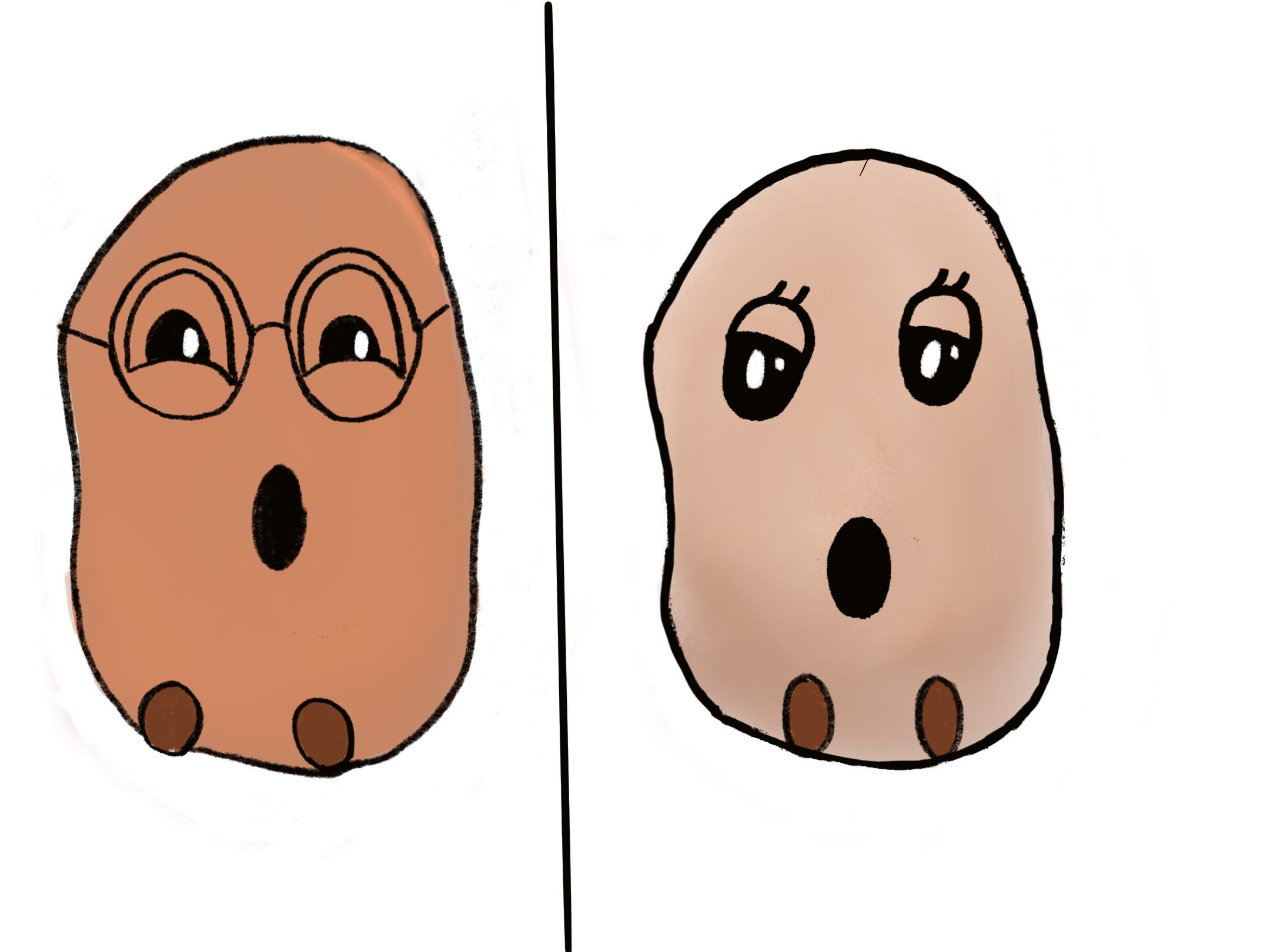
An ordinary potato tries to understand the perplexing world.
Author: Swathi Chandrasekaran
Lover of books, puzzles, sports, dance and coffee to get through them all!
Dedicated to being a Jill of all trades with innumerable interests and a minute managed schedule to help. You can follow me on Goodreads (https://www.goodreads.com/swathichandrasekaran) or drop a note anywhere on the blog to connect.
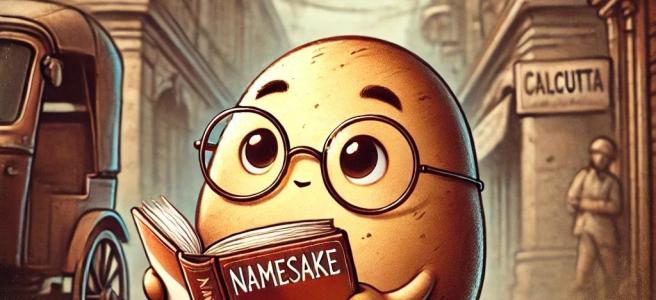
Given that the book is rooted in identity crisis borne from a child’s name, it only seems right to name the author with her full Bengali name. A name that she was given in London, UK by her immigrant parents who later immigrated to the United States when she was 3 years old. That Lahiri deeply understands identity shifts for immigrants was clear on display in the short stories of Interpreter of Maladies; in Namesake, it rubs you raw.
From the start of the book, I was hooked. I was hooked with dismay, as I realized I was in for an emotional read of yearning, longing, growth, grief, and heartache. So much heartache. The book is set in Massachusetts, revolving around the family of Gangulis – Ashoke, and Ashima, a newly married, arranged-marriage couple who settled in a land distant from Calcutta where they’re from. Ashima, having moved after the wedding to stay with her husband, goes through the heart-wrenches of missing festivals back home, missing her family, missing the food, and the Bengali culture, just like each of us who moved here from thousands of miles away. And just like each of us, Ashima and Ashoke slowly settle in, finding their circles of friends who substitute as uncles and aunts for their kids, finding their neighborhood Bengali supermarket, and tailoring new traditions around their festivals. Gogol, their first child, remembers with annoyance how all his birthdays were reasons for his parents to get their friends together, how the boisterous group of Bengalis would crowd in their living room, the pans of cooked food still in their cooking utensils atop the dining table, the endless rounds of food, drinks, and more food. The story then moves to focus on Gogol, as it would for the remainder of the book. I didn’t like Gogol, I didn’t like his entitlement, his disrespect for his parents, or his resentment of all things Bengali. Maybe I saw too much of myself in his parents, it’s hard not to.
As Gogol grows up, we see him make choices – from his friends, to romantic relationships, city he chooses to settle in, and who he chooses to settle with. We see the influence of the choices his parents made reflect in his choices, sometimes directly, sometimes through rebellion. The book follows Gogol’s life, through the everyday, but what touched me the most were the aspects of his parents, and his family back in Calcutta.
The book was heart-wrenching to read, for me, perhaps because it hit a little too close to home.
Sarah Thornton is a sociologist and writer. Most importantly for this book, she is also a patient of a mastectomy, and all the following breast implants and lift surgeries deemed as a package deal. In undergoing these procedures, she started to wonder more about her breasts, and the socio-cultural stigmas and taboos around it. And thereby started her journey of discovery, research, and writing for this book that beautifully presents the issues with how we view breasts, and the implications of it.
The book is broken down into chapters that focus on breasts in different ways: from the sexualization of them in strip clubs, the mammalian function of lactation, to cutting through the flesh in surgical theaters, designing bras for the right fit, and religious and pagan beliefs about breasts, Thornton covers each research area masterfully. She never judges the subjects of her conversation, and in the odd places where she does have biases and opinions, she mentions them explicitly for the readers. The chapter on the operations of Milk Banks in California, which explains the rise and dangers of formula as an alternative to breast milk was particularly insightful.
I learnt so much from this book, which I think makes for an excellent read especially alongside Eve: How the Female Body Drove 200 Million Years of Human Evolution which I’m currently also reading. Some fascinating, startling, and terrifying quotes and pieces of information were:
“In some western African countries like Cameroon and Guinea-Bissau, the presence of breasts makes women so vulnerable to sexual violence that an alarming number of mothers and other family members subject their pubescent girls to a painful process called breast ironing, whereby breasts are cauterized, pounded, and bound over months to try to delay breast development.” https://www.globalcitizen.org/en/content/breast-ironing-cameroon-harmful-practice-girls/
In Mali, ‘she whose breasts have fallen’ is a respectful term for an older woman, not a slur betraying derision or disgust.
In Hindu mythology, Sati Mata, an aspect of Shakthi, sacrificed her life in an immolation in a sacred pyre. Her ashes are believed to have been strewn all across India and the Indian subcontinent, and there are temples associated with each of her body parts, including her breasts and vagina, which are all considered sacred. https://en.wikipedia.org/wiki/Shakta_pithas
“I recently asked my niblings, who attended a public high school in an affluent suburb in New York City, what words their friends use for breasts. My nephew, a 16 year old sophomore who socializes with his mates on the soccer team, openly rattled off six terms, starting with “rack” and ending with “tits”. My niece, an 18 year old senior, said that the only word the girls in her grade used regularly was “boobs”. This disparity in vocabulary is symptomatic of the gender inequalities embodied unconsciously by many Americans. It is also indicative of the larger problem of who defines and controls women’s bodies.”
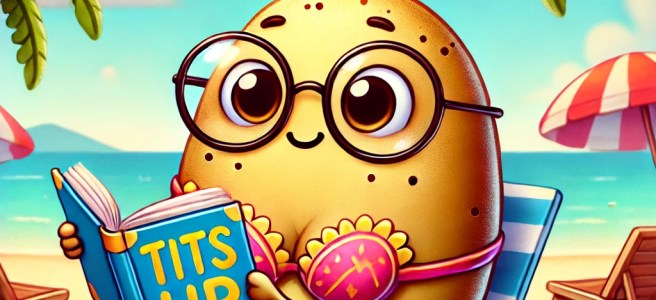
So, what can we do? We can educate ourselves about our bodies, and refuse definitions and depictions from male-dominated society, we can reclaim our words and the power of our vocabulary. We can recommend and promote this book to our friends. We can stand tall, walk with our shoulders back, and walk with purpose and confidence, which we will also henceforth call, ‘Tits Up’.
I’ll end this review by thanking my friend for recommending this book to me, and for letting me borrow her copy of it.
A satisfying wrap-up of all the different plot-lines, scientific theories, and character arcs. That Liu Cixin managed to tie everything together is astonishing to me – a feat I thought impossible even halfway through this read. I found this book to be more challenging of a read than the prequel (The Three Body Problem). There were more rambles, more story-lines that were seemingly unconnected to everything else, more characters, more scientific conjectures produced, and no semblance of a structure to the chaos. That the book skipped chapter markers caused me further pain.
All of which brings me back to this: that the book has a satisfying end to the chaos is mind-blowing to me, and the simplicity of that end is stunning. I think this might be a divisive opinion though, but one I’m happy to hold.
This was a frustrating read, one I’m happy to have gotten through for the story, but I had to stop myself from reading the preview of the last book in the trilogy, knowing that would only suck me into several more hours of this confusing read.
A completely immersive read – the world set up by Liu Cixin is complex, multi-layered, and utterly befuddling in the most compelling way. Even as certain mysteries get explained, more intrigue is created. The prose is confusing – cutting across timelines, geographies, virtual and real worlds back and forth. There are several rambles that don’t make sense in the context of other sub-stories being spoken about, but later tie everything together. The storytelling is utterly masterful – it is inconceivable to me as to how someone could have devised this form or narration, and the translation by Ken Liu reads so naturally it is easy to forget about it entirely.
I purchased the second part of the book with a sense of urgency by the end of the first one, and hope to unravel more of this intricately knotted plot.
Heartache: emotional anguish or grief, typically caused by the loss or absence of someone loved.
OED
The emotion I felt turning the last pages of this poetry of a novel was heartache. A strange numbness, heaviness, and grief having read the lives of Esme, of Da, of Lizzie, of Mr. Murray, of Gareth, of Bill, of Dittie, and of Tilda. Of the women who lived through the heights of suffrage movement in Britain, of boys who grew into men in boots in the trenches of what is now called WW1.
The story revolves around a rather mundane task: creating an entire dictionary of English words, which would later get published as The Oxford English Dictionary. We meet Esme as a child, small enough to fit under the table of her Da at the Scriptorium, watching her father with amazement as he performed his ritualistic duties as a curator of words for the dictionary. I could relate to her awe, to her fascination to Da’s responsibilities, and in a way, to the life and reason of this child of the 19th century.
We watch Esme grow, we see her silent power, the influences in her life and how each of them shaped her, and of the parts of her that remained constant. We continue to relate to her silly rule-breaking, her small lies, her struggles, her decisions. I wondered if I’d have had the power to live through those years in that strange world.
The writing or the prose itself, is quiet – never overpowering the lives on the pages; and the story is shocking, stunning, beautiful, and agonizing in a way that can only be an accurate representation of reality. We watch Esme struggle with understanding the importance of words, and realizing words can hold differing meanings for men and for women, for the rich and the poor. We see her inadequate solutions for that problem. We see her struggle growing into a young woman in the era of suffragettes, of her questions on the methods of protest, her unwillingness to join the violence. We see her struggle with losses, too many of them. We witness the power of a village – of her people who pull her out of each loss, every time. It is all too relatable.
Set in a tumultuous period for women, the novel explores the importance of words, and what erasure of some could mean. The plot unravels this concept around the thick of suffragettes, suffragists, suffrage, the germination of feminism, the world of needless wars, upended lives, and most of all, of words.
Beautifully written, beautifully put together, this is a story and an emotion that I’ll hold close to my heart for years to come.
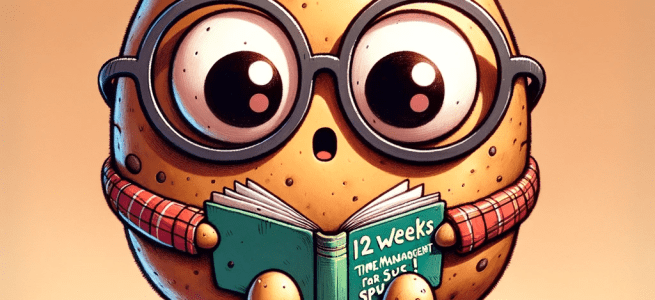
The first thing I’ll say is that the 250-odd paged book is actually a 250-odd paged book. It isn’t an over-elaborated blog post, or a single idea reiterated. I can’t tell you what the “core idea” of this book is. The book is the length it is because it needs to be. Ironically, most productivity books are longer than they need to be, and repeat their core theories over and over. In any case, this isn’t a typical productivity book – it doesn’t have tools to manage to-do-lists, or hacks to drive efficiency metrics.
Four Thousand Weeks. Four Thousand Weeks is the average human lifespan. It’s the same as 75 years, or 28,000 days – and yet, it means something subtly different. 4000 weeks feels smaller than 75 years – we know a year is a long time. It also feels shorter than 28,000 days. 28,000 is too large a number for me to comprehend. A week flies past though, and imagining 4000 of them flying past is easy. And therein, terrifying.
It’s hard to distill this book down to some key learnings – it was a fluid read, with each chapter bringing up concepts that may resonate with the readers in a different way. So instead of trying to boil down the book, I’ll leave some notes that stood out for me. And I’ll hope that it encourages you to pick up this book.
Why You Should Stop Clearing the Decks
…Despite my thinking of myself as the kind of person who got things done, it grew painfully clear that the things I got done most diligently were the unimportant ones, while the important ones got postponed — either forever or until an imminent deadline forced me to complete the, to a mediocre standard and in a stressful rush. The email from my newspaper’s IT department about the importance of regularly changing my password would provoke me to speedy action, though I could have ignored it entirely. Meanwhile, the long message from an old friend now living in New Delhi and research for the major article I’d been planning for months would get ignored, because I told myself that such tasks needed my full focus, which meant waiting until I had a good chunk of free time and fewer small-but-urgent tasks tugging at my attention. And so, instead, like the dutiful and efficient worker I was, I’d put my energy into clearing the decks, cranking through the smaller stuff to get it out of the way–only to discover that doing so took the whole day, the decks filled up again overnight anyway, and that the moment for responding to the New Delhi email or for researching the milestone article never arrived. One can waste years this way, systematically postponing precisely the things one cares about the most.
The Pitfalls of Convenience
Convenience, in other words, makes things easy, but without regard to whether easiness is truly what’s most valuable in any given context. Take those services–on which I’ve relied too much in recent years–that let you design and then remotely mail a birthday card, so you never see or touch the physical item yourself. Better than nothing, perhaps. But sender and recipient both know that it’s a poor substitute for purchasing a card in a shop, writing on it by hand, and then walking to a mailbox to mail it, because contrary to the cliche, it isn’t really the thought that counts, but the effort–which is to say, the inconvenience. When you make the process more convenient, you drain it of its meaning.
Rediscovering Rest
Taking a walk in the countryside, like listening to a favorite song or meeting friends for an evening of conversation, is thus a good example of what the philosopher Kieran Setiya calls an “atelic activity”, meaning that its value isn’t derived from its telos, or ultimate aim. You shouldn’t be aiming to get a walk “done”; nor are you likely to reach a point in life when you’ve accomplished all the walking you were aiming to do. “You can stop doing these things, and you eventually will, but you cannot complete them,” Setiya explains. They have no “outcome whose achievement exhausts them and therefore brings them to an end”.
The Last Time
Sam Harris makes the disturbing observation that our life is a succession of transient experiences, valuable in themselves, which you’ll miss if you’re completely focused on the destination. This applies to everything: our lives, thanks to their finitude, are inevitably full of activities that we’re doing for the very last time. Just as there will be a final occasion on which I pick up my son, there will be a last time that you visit your childhood home, or swim in the ocean or make love, or have a deep conversation with a certain close friend. Yet usually, there’ll be no way to know, in the moment itself, that you’re doing it for the last time. Harris’s point is that we should therefore try to treat every such experience with the reverence we’d show if it were the final instance of it. And indeed there’s a sense in which every moment of life is a “last time”.
So here’s to seeking out atelic activities, relishing in valuable inconveniences, being less hungry to see the bottom of your to-do-list, and cherishing each experience like it could be the last time.
Notes from the day I had Lasik + other eye related trivia
January 5, 2023
For the last 20 years of my life, the first thing I’ve done in the morning has been to fumble for my glasses. After every good night’s rest, and every not-so-good uncomfortable nap in cars. In the car, it’s usually tucked away into the seat pocket in front of me while I sleep on my mum’s lap. At home, despite all my promises of consistency, they move everyday — sometimes on my desk, sometimes atop the rightful bedside table, sometimes curiously placed within last night’s book under the bed, but mostly, they lie in bed next to me when I sleep alone. So each morning I fumble with the sheets, feeling for the frame with my hands. I’ve even sought help in this regard – yelling for my parents on school day mornings to aid in my searches.
Usually, they never come off after, apart from the aforementioned naps in cars, swims, and showers. Swims are usually an adventure of their own while showers are relatively easy, especially in known terrain. Even still, I carry my glasses into the shower each time, taking them off at the last possible second. I put them back on immediately after, making my way out of the bathroom with foggy and wet vision.
When I swim, I usually study the pool before jumping in. I’ve also gotten good at judging distances and velocities of oncoming traffic of swimmers. I’ve only bumped into a handful of swimmers in all of my experience. Finding friends however, is a more challenging chore. Over the years I’ve memorized the colors of their swim caps — the bright neon of my brother, the blue and teal of my best friend — beacons in the pool. Mostly I assume that since they’ll be able to see me, things are okay, and this strategy has worked.
The ocean is a different terrain, literally. Here, what bothers me is not even the crowd of strangers and the conspicuous absence of swim caps. It’s the sand underneath! Or what is supposed to be sand underneath. Each step is panicky, unknowing of whether I’m about to step on sand or stone, or — and you can call this an irrational fear — a starfish or a toad. I’ve worn my glasses in the ocean more times than sensible.
It’s surprising to me therefore, in all my years adorning these fragile equipments atop my face that I’ve only broken 3 pairs of glasses. Most recently, last year, by taking a football to my face. When I was 14, I had the acute stupidity of purchasing the then fashionable, and to-date utterly impractical ‘frameless’ spectacles.
Predictably so, I broke them playing with my cousins. Unpredictably, we were playing a ‘game’ we called War wherein two opposing teams (usually formed on pre-existing rivalries) would wield anything within a child’s bedroom as a weapon and throw all things from pillows to tennis balls, sketches to badminton racquets at each other until a team (or usually one injured player) calls quits. That we only broke a pair of frameless spectacles (and a lot of ego) in these games is by itself a miracle worth dwelling on. That all it took was my youngest cousin’s soft plushie to my face is, if anything, cute. We later got the ‘frames’ fixed and repurposed as my amma’s spectacles. I got dealt a marginally more practical metal frame.
I’ve squished metal frames innumerable times, and they’ve portrayed immense resilience each time. Mostly they’d just get malformed, like play-dough. In a careful adult’s hands, they’d be back to perfect in seconds. I always handed mine to my mum’s surgical, sure hands. I’m not sure how my dad would have fared.
The third and final time is a hazy memory. I can’t tell if I’m making it up. I was in 3rd grade. I had a pair of metal glasses. My vision was good enough that I could make do without glasses, although I wore them most of the time. I recall placing them on the railings of my school corridor on the 3rd floor. I remember wondering if they’d survive the fall (some kid in my class had boasted that his had). I remember then running downstairs to pick up my unscathed pair of glasses from the hot, dusty ground. Whether I had intentionally dropped them or the wind had carried them over — I don’t know. Hell, I don’t even know if I’ve made this memory up. I’m just realizing that in any case, they didn’t break, so this incident doesn’t count. Never-mind then.
I’ve been called ‘butti’ (Tamil colloquial word for glasses that is mildly insulting) all the time. I’ve grown rather dear of that nickname.
Wintry, unspectacular potato looks back perplexedly at its past framed face.
Outside of a few trials and tribulations with lenses, butties have been a staple diet on my face for 2 decades. I have my LASIK (laser assisted in situ keratomileusis, or one of those words that you’ll know is an acronym but can’t quite place) procedure scheduled for today and I know it isn’t a big deal. I know it is a simple procedure. I know millions of folks have undergone this. I’m not scared (well, I’m not terrified). I’m certainly sentimental though.
– Butti
First few thoughts post-surgery:
My ophthalmologist lied when he called this a painless surgery.
If one eye hurts more than the other, does it mean they botched half the surgery?
Where are my glasses?
My head hurts. On one side. Refer to (2).
I need to remove my lenses/my eyes are dry. (Post surgery, eyes tend to dry out since a part of the procedure cauterizes nerves that connect the cornea to tear glands. This leaves the eyes with a contact-lenses-worn-too-long feeling.)
Whoa, did the window always have so many cracks?
How do people sleep with so much entertainment? One routine I’d created unknowingly was a ‘bedtime mode’ for my vision. Like turning off blue light or setting your phone on B/W mode, removing my glasses made the world dimmer, a bit duller. The world was now too entertaining to just go to sleep. This took a few days to get over.
I can SEEEEEEE! (This I repeated so many times I’m surprised no one has told me off, yet.)
More on eye-related things!
What is Astigmatism, anyway? Here’s a 110 second video with a 60 second explanation.
‘Starry-Eyed’ can mean you’re an optimist with impracticable thinking. It could also mean that your retina has been detached from the back of the eye by the vitreous fluid and that you need immediate medical attention. As we say it, potato, po-tah-to.
Strawberry Squids, besides having a bizarre name, outdo the rest of us puny species with an asymmetric evolution in vision. The two eyes of the squid are differently sized — one is almost twice as large as the other, and are positioned differently to allow for separate functions. The larger eye is positioned to look up, to sight shadows using the dim sunlight that pervades the depths of the ocean. Sunlight can only permeate up to 200m under the ocean’s surface and Strawberry squids can be found up to 1 km under the surface. The smaller eye on the other side of the head looks down for bioluminescence in the water.
‘Madras Eye’ or conjunctivitis is an infection to the outermost portion of the eye that can be caused by virus or bacteria. The common name of ‘Madras Eye’ doesn’t seem to have an obvious explanation, apart from a singular pithy article in The Hindu claiming that the virus was first discovered in Madras in 1918. I suppose ‘Madras Eye’ has a better ring to it than ‘Chennai Eye’.
Hindsight is always 20/20 or 6/6? From the 20/20 of visual acuity, the phrase generally means that things are obvious in retrospection that weren’t clear at the onset. I recently found out 20/20 is the same as 6/6 – one’s in imperial units and the latter is in meters. 6/6 means you, at 6 meters away can see what an average person can see at 6 meters. Having a vision of 20/16 would mean you have superior eye-sight, you can see at 20 what the average person can only see from 16 feet away.
Resolutions are for people who have flaws and fallibilities, never mind the rest of us
It’s that time of the year again!
Like our calendar, our resolutions also have European roots. January, derived from the name of a Roman God Janus, represents the month when Romans would promise the God to be on their best behaviour, which back then was displayed by paying their debts and returning ‘borrowed’ objects. Janus is one of Rome’s rare own Gods, with no counterpart in Greece. Depicted as the god of transition, Janus is imagined to have two faces – one looking back at history, and the other facing forward, into the realms of future. (Given such mythological powers, which direction would you look?)
On that note, here are some of our inspirations for setting resolutions for the year!
And on setting supersized themes instead, from CGP Grey: (Clearly I couldn’t make up my mind on which one works better and chose the lazy way out by leaving the readers to decide).
Whatever your resolutions are, one recommendation from us is to have regular check-ins to see how you’re tracking and adjust the goals accordingly. This app has worked well for half of us who’ve tried it.
How do you plan to send wishes for the new year? What do the wishes mean grammatically, and behaviorally (I think):
Happy New Year!
Only valid for Jan 1, or a few weeks in January for the perpetually tardy.
Happy new year!
The more generous wish – here’s to wishing 364 times more fun than the folks above.
Happy New Year’s!
New Year’s what?
Happy New Years!
Talk about being generous! They’re wishing a wonderful rest of your life (whether that means they never intend to ever meet you again, we don’t know).
Happy 2023!
We see what you did there. Smart.
I don’t partake in such trivialities of humankind. I’ll abstain.
For insulation, primarily. Some kind of covering for feet were used in cold northern climates as early as 500,000 years ago, and the earliest forms of shoes for support are estimated to have come into use 40,000 to 26,000 years ago.
How do we know this? By examining the bones of early Homo Sapiens and Homo Neanderthals. Wearers of shoes tend to develop weaker toes owing to a reduced need for strength and flexibility, with the shoes doing most of the work of gripping ground. Studies have shown that Native Americans who were regularly barefoot had stronger toes than Inuits in Alaska who wore insulating footwear, proving that the weakness/strength of toes is not evolutionary!
In another case of barefoot behaviour, one of the earliest hunting strategies of humans relied heavily on long-distance running. Hunters (ancient versions of us) chased the prey until the latter eventually tired and slowed down. At this point the early humans could kill from short distances – typically by clubbing/stoning. This also gave them the unique ability to attack other predatory creatures, which were incapable of sustaining their speedy, lithe attacks over long periods time. Called ‘Persistence Hunting’, this could make for several hours of heated pursuit – the kind that would warrant a $100 pair of running shoes today.
… all of which leads us (un)comfortably to why I started thinking about this in the first place — heels hurt — the Sam Edelman and Jimmy Choo kind, not the Achilleskind. With return to office around the corner, I returned to the long-forgotten pain of shoe bites (albeit just a hybrid thrice a week for now), and to the nagging question of why we wear shoes.
While I started with achy heels, my blissfully unaware co-author researched sneakers and their evolution, of which we’ll definitely not hear about in the next issue (scheduled for 6 shoe bites later). I’m sure it’s going to be rant on rubber soles or something.
What’s that and why?
Stilettos: Thought to be named after long pointy needle-like swords of Italian origin. The word itself comes from Latin ‘stilus’, a thin pointed Roman writing instrument for engraving wax or clay tablets. The same root word also gave rise to ‘stylus’.
Etymologically strong Perplexed Potato ordered the wrong item
Bata: Founded in 1894 in today’s Czech Republic, named after the founding cobbler Tomáš Baťa. (Did you also think it was an Indian company? No? Neither did we…)
Hawai Slippers: The ultra comfortable, all-withstanding tropical slippers made of rubber we wore growing up are not universally known as the ‘Hawaii slipper’. In fact it’s spelt ‘Hawai’ and was the name given to the sandals by Bata, which introduced and popularized the style in India. Most of the world calls them by their onomatopoeic name ‘flip-flops’. They’re called ‘zoris’ in Japan, ‘jandals’ in New Zealand, ‘plakkies’ in South Africa, and confusingly known as ‘thongs’ in Australia. Hawaiians call them ‘slippers’.
A book that is quintessentially David Mitchell. For those who haven’t had the fortune of seeing his sharp-wit on various BBC 4 shows, I’d highly recommend any of them. I wish I could go back to discovering his sensibilities once again to relive the joys of hearing his logic for naming children and his proclamations against the murder of grammar and apostrophes.
My recent crush on David Mitchell notwithstanding, this is still a solid book on the current affairs in Britain (where I do not live, but I also do not need to explain to you the reasons I picked this book up). The book itself is a collection of David Mitchell’s essays for The Observer (which, between him and Nick Hornby, has given hours of joyous content to dive into for someone who’s never set foot in England). So the essays themselves were once-upon-a-time topical, now brought to life only by Mitchell’s relentless pursuit of common-sense arguments and the broader scope of some debates.
Here’s an excerpt from the introduction:
Obviously, people have always lied – so we shouldn’t get too excited about our own society, as if it’s done something which, while admittedly bad, is devilishly inventive, like feeding Christians to lions or devising whiskey. Lying is as old as the hills. Older than ones made of landfill, which I suppose are lying about being hills.
Personally, I lie quite often, mainly about whether I am free to attend social events. It’s all because the phrase “I can come but I don’t want to” seems not to be permitted. There’s no way of dressing that sentiment up so that it’s socially acceptable. I’ll have a go, though:
“It’s so kind of you to invite me and I am sincerely grateful for the thought but, on that day, I know I will be tired and would prefer to stay at home, and I very much doubt that you’d really want me to come if I really don’t want to myself, so if it’s OK, I won’t”.
You see? Won’t do. At best you’d get some sort of diagnosis. And you’d hurt the inviter’s feelings. And the inviter would think less of you – that’s the real kicker.
So there’s nothing for it but “Thanks so much — I’d love to come, but sadly I’ve got to [insert lie here].” It’s the only way of availing yourself of your liberty not to attend without breaking social convention. If you believe in freedom and you don’t want people to think you’re a dick – and the vast majority of us fall into this category – you’ve got to lie, and lie well.
It’s a bit crazy really. As a consequence, we live in a world in which ostensibly everyone wants to go to everything they’re invited to. They always want to, but sometimes they just can’t. The notion of people not wanting to go to parties that they’re actually free to attend is not openly acknowledged by our society. It’s like prostitution in the Victorian age: it’s happening everywhere, but everyone pretends it isn’t.
David Mitchell in Dishonesty is the Second-Best Policy
You’d only find such gems if you’re willing to read his writings on Eton students’ visit to Russia, Theresa May’s thoughts on counter-terrorism, rude street names in England and being rich in London. If you’re a lover of David Mitchell’s wit or live in UK, I’d happily recommend this read. If not, perhaps start by watching QI, WILTY, or any of the other BBC 4 panel shows, until you’re in one of the two categories.



 Perplexed Potatoes

