An ordinary potato tries to understand the perplexing world.
Author: Swathi Chandrasekaran
Lover of books, puzzles, sports, dance and coffee to get through them all!
Dedicated to being a Jill of all trades with innumerable interests and a minute managed schedule to help. You can follow me on Goodreads (https://www.goodreads.com/swathichandrasekaran) or drop a note anywhere on the blog to connect.
Onto Chapter 2 – Womb, where more of my utter lack of knowledge is revealed in the form of things that I learnt.
Horrors of Motherhood
Many salmon species die soon after spawning eggs, mostly due to the strain the upstream journey demands from them. Their corpses fertilize the waters for the new hatchlings.
More terrifying are certain species of fireflies, which don’t possess mouths as adults. They live frenzied lives aimed at reproducing, laying eggs, and dying before they lose all the resources their body has consolidated from their pupal stage. I’ll never be able to see fireflies the same.
Most marsupial babies are born at what humans would call an ‘incredibly underdeveloped’ state, or about 7 weeks into what a human baby would be. They are born with absurd forearm strength though, and are able to hoist themselves and clamber into their mother’s pouches. Researchers have recorded ultrasound videos of wallaby fetuses practicing this movement in their mother’s wombs! Here’s a video of it, maybe it would make more sense to you than it did to me.
Placental Wars
The placenta is one of the only organs in the world made by two separate living organisms – both the embryo and the mother contribute to it.
Preeclampsia, with an occurrence rate of over 5% in American women, is a life-threatening high blood pressure disorder associated with pregnancy. While the disorder can be controlled through frequent checks and blood pressure medication, the only real cure for it is to deliver the baby and placenta. It is caused by two proteins in the uterine lining that are responsible for increasing blood pressure in the arteries to enable the delivery of more blood and nutrients for the growing fetus. When they overdo their job, they cause higher blood pressure which leads to preeclampsia. There is interestingly, a third protein in the mix whose role was understudied until recently.
After implantation, the placenta sends out trophoblasts—cells that attack the uterine lining to secure resources for the embryo. The mother’s body doesn’t exactly greet this politely; it responds like an immune system confronted with an invader. So the mother’s body retaliates and attempts to decimate these invading trophoblasts. The human placenta, a step ahead, has devised sneaky ways to avoid this!
PP13, the third protein we spoke about, attacks veins around the uterus to cause a distraction for the trophoblasts to get in and do their thing.
In a healthy pregnancy, we want the placenta and the uterus to be in this war for 9 months, with neither side winning – a happy stalemate. If the placenta starts losing, it brings out more trophoblasts, causes more inflammation to veins in the uterus, and generally causes more havoc and brings on preeclampsia to the mother.
Ah, the wonders of motherhood.
Studies on the pros and cons of pregnancy are confusing:
Women who never give birth are less likely to develop autoimmune diseases compared to women who have given birth at least once.
Women who have given birth in their 20s are less likely to be at risk of certain kinds of cancers compared to women who have never been pregnant.
Also in the chapter:
Chicxulub, the apocalypse from an asteroid, 66 million years ago which wiped out all non-avian dinosaurs.
Permian Extinction Event, The Great Dying, considered the largest extinction event on our planet, 250 million years ago.
This book is a significantly dense read, measured as new-information-for-Swathi per word-read. Due to this, the book has lent some difficulty to my memory, while simultaneously serving as one of the most fascinating reads from this year. To do justice to this work, I’m planning to write a review per chapter of the book, focused on the things I learnt from it.
Chapter 1: Milk:
I feel silly for not having known any of these before I read this chapter, but as a pampered youngest child, I never grew up around infants/babies in a manner to see these in reality. You’d probably have heard some of this at home growing up if you have a younger sibling. Perhaps. Or maybe you grew up with more superstitions and you’re not sure of what’s based on science – so this list could help!
Feeding Basics:
Apparently, human babies aren’t given water until they’re 6 months old! If they’re thirsty, they should be given more milk or formula.
Non-Human Mammals are also Weird:
Platypuses don’t have nipples: newborns lick milk from milk patches on the mother’s stomach.
When today’s leather-egged (typically reptilian) offspring are ready to hatch, they lick up the egg-coating goo. It’s usually their first meal.
Totally unrelated, but I finally learnt what century eggs in Asian restaurants are! They’re eggs preserved in an alkaline medium like clay, which causes the yolks to blacken and the whites to brown. It also adds a sulphuric flavor from the ammonia in eggs. The Chinese name translates to something like “leathery eggs,” and that tenuous connection made it feel acceptable to shove this fact in here.
Colostrum:
Humans didn’t believe in the importance of breast milk, and believed colostrum to be rotten milk. In the 15th century, a German author Bartholomaus Metlinger wrote:
“The first 14 days it is better that another woman suckle the child, as the milk of the mother of the child is not as healthy, and during this time the mother should have her breast suckled by a young wolf.”
Meconium, a baby’s first poop, is alarmingly green, tarry, and thick. It’s mostly broken-down blood and protein that the fetus ingested before delivery, and it’s important that it’s discharged soon after birth. Colostrum acts as a laxative, helping wipe the baby’s stomach clean. This is why newborn babies typically lose weight after birth, until the colostrum switches to milk and the baby can start digesting food and fats.
Biotics:
Breast milk is mostly water: it also contains proteins, enzymes, lipids, sugars, bacteria, hormones, maternal immune cells, minerals, and oligosaccharides. These stand out since they’re not even digested by the baby’s body – they’re prebiotics that ensure the growth of friendly bacteria in the baby’s gut! The prebiotics help promote good bacteria and annihilate harmful ones.
Probiotics = ingesting bacteria that the human body should already contain. Prebiotics help these bacteria thrive.
Apparently, synbiotics are a combination of prebiotics and probiotics, and postbiotics are what the probiotics create when given prebiotics…now that seems like crazy-town.
C. difficile infections, which threaten the lives of patients who have been subjected to heavy doses of antibiotics, occur due to the annihilation of good bacteria from the patient’s digestive system. Recently, they’ve found a reliable treatment for it: pumping a brown slurry of a healthy person’s poop into the patient’s intestines. Fecal Matter Transplant is being studied in the US.
Mechanical Engineering of the Nipple:
Montgomery glands are responsible for creating a lubricant over the nipples to prevent chafing from a baby feeding.
The nipple is packed with nerves to detect a vacuum being created by the baby’s mouth and sucking, which starts the chain reaction of oxytocin being released. This is why we can use a breast pump to simulate the same reactions.
Baby’s saliva creates a feedback loop for the brain: it’s a two way communication. The saliva is used to understand what the baby’s body needs, and the brain creates the appropriate mix of proteins and hormones in the mother’s milk to feed it. This is not replaceable by a breast pump.
Breast cancer is the second leading cause of death in women, after cardiovascular diseases. We’ve become better at managing the impact of breast cancer by learning to diagnose it sooner, and testing more frequently. The incidence rate of breast cancer in humans has not changed, and is around 1 in 8 American women over their lifetime.
Min Jin Lee’s Pachinko is a masterwork. The story begins with Hoonie, a quiet, resilient man whose death leaves behind Yangjin and Sunja. But as the pages turn, the focus shifts from mother to daughter, to in-laws and grandchildren, each carrying generational scars in their own way.
In Sunja and Kyunghee, I felt the pain of women in the extreme patriarchal society of Korea, hated Yoseb for being the head of the family, for overruling the women in his household who often made better, and more practical decisions. In Solomon, I recognized parts of my own daily struggles as an immigrant: of not knowing when I fit in and when I don’t, or even when I want to, and when I don’t.
The book is based on 20th century Koreans, primarily set in Osaka. With it, it brings the background of Japan’s annexation of Korea, racism, subjugation, and loss of identity of Koreans displaced, stories of families who move from Korea to Japan in search for stability. Min Jin beautifully narrates these struggles with historical context, first from annexation, through colonial oppression, later the second world war and the bits of pieces of news Sunja’s family hears about the Americans and the wars. At their best, Sunja’s was middle class family of Korean immigrants settled in Osaka, at their worst, they’d endured starvation, deaths, and unimaginable losses. Even at the very end, in Solomon’s adulthood in the 90s, we see impacts of stereotyping and racism on Koreans. The author doesn’t take us through the struggles of war from the front-lines, but explores it from the confines of the day to day of the hopes and dreams of Sunja: through their worn-out clothes and ingredients in their pantries.
I’d happily recommend this book to someone who’s looking for a deeply emotional work of fiction: one that is similar to Ruth Ozeki’s or Jhumpa Lahiri’s prose.
I gave this book a second shot after dropping it over a year ago. A friend insisted it was an informative read, so I dove back in despite the denseness of the author’s writing. I still found the writing to be strained, and the author struggles with explaining scientific concepts and genomic research fluidly. His writing about history is much more enjoyable to read, but the science is necessary to comprehend the history which made the overall read a tad arduous. The effort is worth it though – I personally learnt a lot about Indian pre-history, the answers that DNA research has now brought to light that didn’t exist even 10 years ago, and how that corroborates or contradicts stories and theories I’ve heard growing up.
On Writings and Maps
My other overall gripe with this book is the poor use of imagery and maps. They exist, yes, but they were undoubtedly added as an after-thought. Perhaps the editor thought the sub-200 paged book would ‘not cut it’ and added padding with some maps and illustrations. Whatever the reason, the book could have benefitted from illustrations that were more relevant, and better placed with the narratives.
Example below depicts my annoyance: the page on the left is incomplete, with a half-sentence hanging off that would need the reader to flip past the map to complete the author’s train of thought. In doing so, oops, you’ve now skipped the map that would have helped understand the geography of what the author is speaking about, so you need to go back.
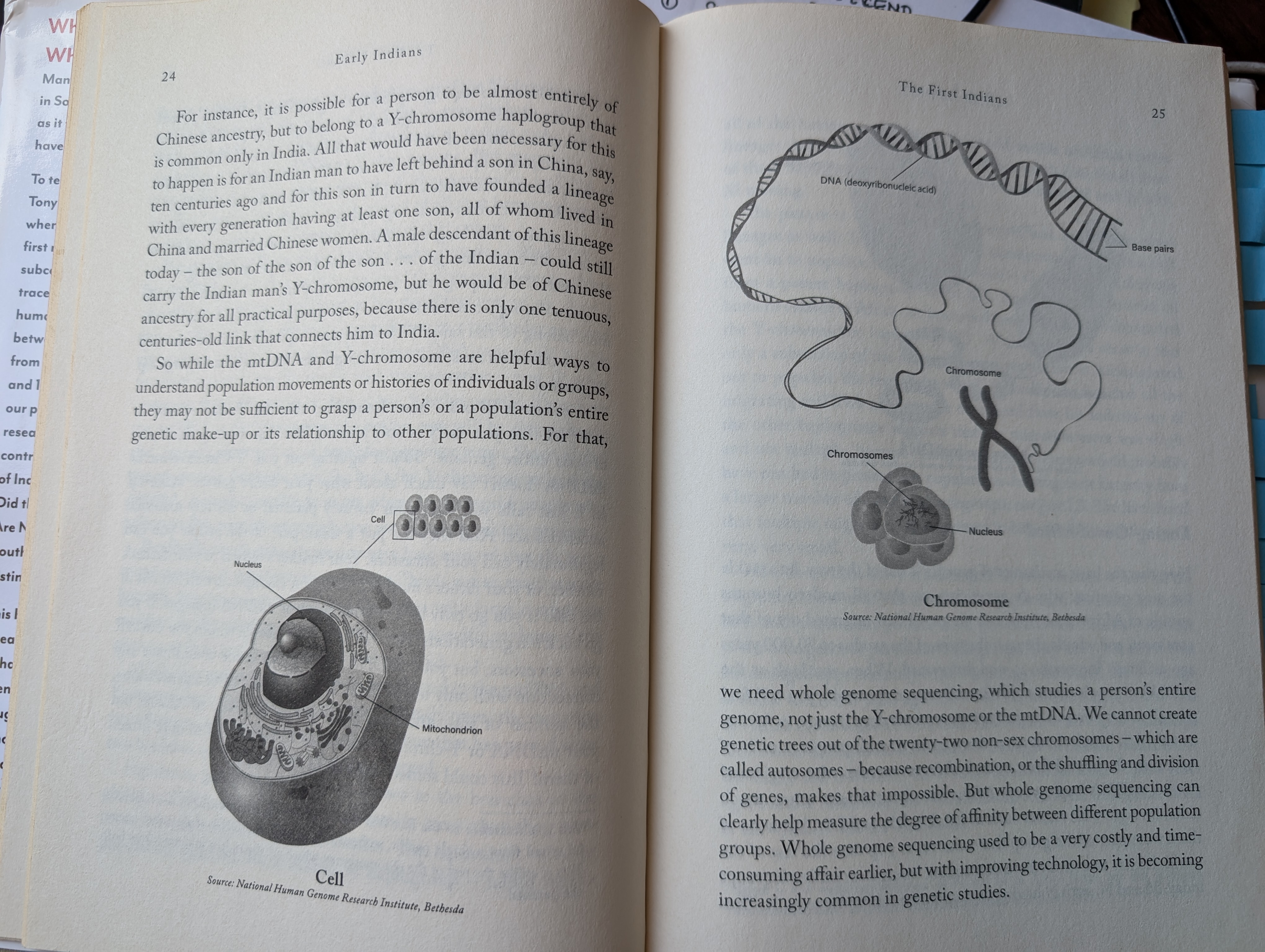
Sometimes, the images are irrelevant to the current topics of dense, scientific explanations – this left me infuriated a couple of times. Here is a page from early in the book where the author sets out to explain some pretty complicated genomic science, how mtDNA and Y-chromosomes are passed along generations, and how they have been helpful in our current understanding of history alongside archeological evidence. Alongside this complexity, we get some fairly irrelevant cell diagrams: the connect is ‘biology’, I guess?
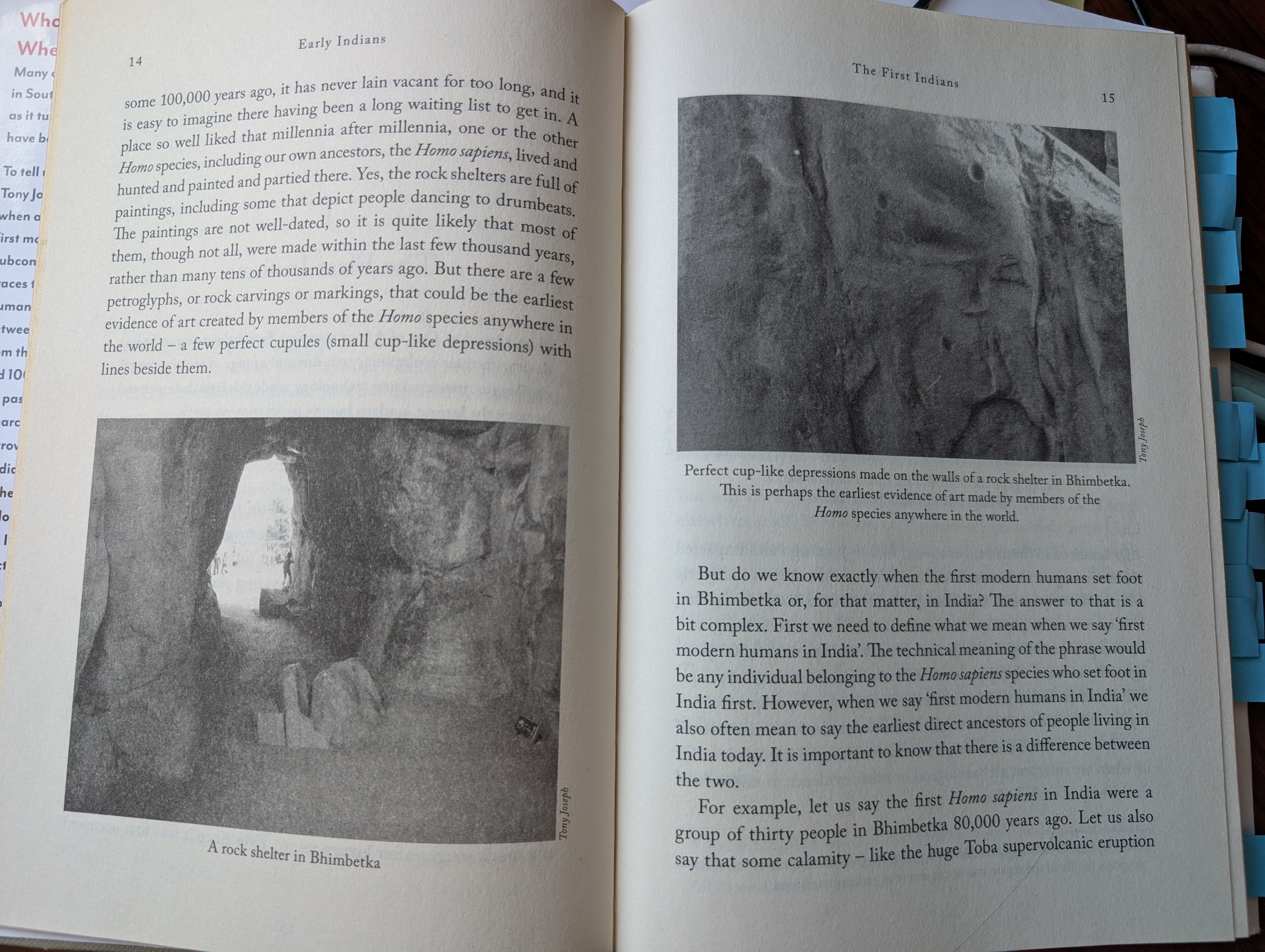
Here’s another page for comparison where I’d argue that the architecture of the prose and imagery were done right! We have the author narrating early Indian evidence and humanity’s first artistic endeavors from the Bhimbetka caves in Madhya Pradesh, and after a crisply ended sentence we see images of both the caves, and the early Homo Sapiens’ art in the photos provided – we just needed more of these, and less of the cases above! Would have made the read a lot more pleasant!
Fascinating Lessons
Alright, gripes about the editing of the book aside, here are some fascinating things I learnt from this read!
India has not invested enough in the understanding of our early history. The resources provided to archeology seem quite minimal, leaving a lot of unturned places of history. Tony Joseph says that one of the places we should visit to get a sense of the grandeur of the Harappan Civilization would be to visit Dholavira in the Great Rann of Kutch in Gujarat, a 7 hour drive from Ahmedabad. Dholavira was a crucial hub for the Harappan Civilization’s overseas trade with Mesopotamia!
Unicorns were a part of Proto-Indian history too! The commonest seal in the Harappan Civilization, about 60% of all discovered seals have the image of a unicorn. So much so that it is believed to have been a ‘state symbol’ similar in importance to the Ashoka Chakra today. (Did anyone else think Unicorns were a western fascination?)
Reconstructed Proto-Dravidian vocabulary helps identify the timing of when Proto-Zagrosian and Proto-Dravidian languages (and hence people) separated: not before animals like goat and sheep were domesticated, or early forms of agriculture, but not after writing was invented. ‘Tal’ which means to push in Proto-Dravidian, means to ‘write’ in Elamite (language spoken in Elam, in present day Iran). McAlpin explains that the original meaning of ‘Tal’ was to ‘push in’, and since early cuneiform writing involved clay tablets with the same action, the word went on to take the second meaning of ‘writing’ in Elamite after writing was invented. Proto-Dravidians must have separated from Elamites before writing was invented, and therefore the word never acquired this meaning! The word for writing in Dravidian languages instead derives from ‘drawing’ or ‘paint’.
The worship of the phallic symbol could have been as old as the Harappan Civilization. After Indo-European language speakers reached South Asia, the language of the Harappans became limited to South India, while the culture and myths melded with those of the new Indo-Aryan-language-speaking migrants to create what we now perceive as the core of Indian culture.
Those who brought Dravidian languages to south India (around 2800-2600 BCE) must have been pastoralists.
One of the ways scientists determined where Dravidians had lived was by analyzing the names of towns and cities at different points in history: a name that ended in ‘palli’ or ‘halli’ would have been derived from Dravidian languages, and would help point to the latest stage at which the population used a Dravidian language for daily interaction.
Languages spoken by Indians today fall into four major families. That I hadn’t learnt this before stunned me.
Dravidian: A fifth of Indians (including me!) speak a Dravidian language which has no language-kin outside of South Asia
Indo-European, is spoken by over 75% of Indians today and is spread all the way from South Asia to Europe
Austroasiatic: spoken by just 1.2% of the population in India and is spread across South Asia and East Asia
The short explanation for the presence of Austroasiatic language in India is that it arrived from South-East Asia around 2000 BCE as a part of the farming migrations in China. Based on the sub-species of rice harvested in India and in China, science has also shown that rice farming was not brought to India from China.
These fall within one of two families of languages: Munda, or Khasi. Both these are related to Mon-Khmer languages of Vietnam, Cambodia, and parts of Nepal, Burma, Bangladesh, Malaysia, Thailand, Laos and southern China. Nicobarese is also an Austroasiatic language.
Munda is spoken in eastern India, particularly Jharkhand, and in central India in Madhya Pradesh and Maharashtra
Khasi is spoken in Meghalaya and to some extent in Assam
Tibeto-Burman: spoken by under 1% of Indians and is spread across South Asia, China, and South-East Asia
The Yamnaya, a civilization from Kazakh (and a part of the Steppe Herder lineage) burst upon Europe around 3000 BCE, a thousand years before their descendants reached South Asia. The new influx into Europe by these migrants were identified using their Corded Wares, a distinctive style of pottery.
Yamnayas were a male centric population. A small number of males must have been wildly successful in spreading their genes, based on genomic evidence. Local pre-existing Y chromosomes get wiped out dramatically after the invasion by Yamnayas.
Basque is the only indigenous non-European language left in Western Europe today (derived from pre-Steppe migrations)
These migrants from Steppe had a clear preference for a non-urban, mobile lifestyle which could be part of the reason why India had to wait for over a millennium after the Harappan Civilization for its second urbanization.
On the Vedas:
Indian culture is not synonymous with Vedic culture: Harappan civilization precedes the earliest vedas, and hence also the earliest instance of the caste system
Rigveda denounces ‘Shishna-Deva’ or phallic-worshippers, while the Harappans leave no doubt that phallus worship was a part of their faith. In fact, archeologists have found clear evidence of the deliberate destruction of phallic idols and symbols in Dholavira and other sites.
There is no horse-related imagery in Harappan culture, and an abundance of it in the Rig-Vedas
Rigveda has a word for Copper ‘ayas’, since later when Iron was discovered, the word ‘krsna ayas’ was used to describe it – settling the timeline for the vedas to have been written somewhere between 2000 BCE and 1400 BCE: meaning the earliest veda post-dates the Harappan Civilization.
Caste System materialized out of nowhere, literally. It did not come with the Aryan migration (or the Steppe/Yamnayas), nor was it created at the same time as the Rig Vedas. In fact, DNA evidence shows that even until 100 CE, the populations in the sub-continent were mixing with each other. Around 100 CE however, genetic evidence shows that the inter-mixing stopped: as though a new ideology imposed on the society new restrictions and a new way of life. “It was social engineering on a scale never attempted before or after, and it succeeded wildly, going by the results of genetic research”. The 4 varnas are mentioned in the part of the Rig Veda most likely believed to have been written later, and the oldest veda also makes no mention of occupational roles for these varnas.
Genetics and Food Habits: Consumption patterns for dairy in India point to a clear demarcation that northern and western parts of India consume more milk and milk products than southern and eastern Indians. They also consume less meat and fish than their southern and eastern counterparts. It’s been shown that a specific mutation 13910T which originated in Europe 7500 years ago is responsible for allowing humans to digest milk beyond infancy. (Fun fact: Humans are the only species to have known to develop this mutation and be able to digest milk past infancy. All the cartoons we see of an adult Tom drinking milk is a lie, and milk for adult cats is mildly poisonous to their lactose intolerant selves. Kittens can drink milk, just as all human babies can digest milk.) This mutation is of particular interest here since a countrywide screening of DNA samples shows that lactase tolerance reduces as we move from North-West India to South-East.
Overall, this was a fascinating read that I’d recommend, one that is worth the wrestling with some dense pages.
I spent 5 unexpected days in and around Anchorage Alaska this July. Our friend works there and, in a moment of weakness, offered to host us. We took him up on it — with two New York friends we’d never traveled with before. It turned out beautifully.
Sibi and I spent the first twenty minutes of our trip to Alaska Google-Searching and ChatGPT-ing our plans in Anchorage’s airport. While we were both looking intensely at our phones, a stranger at the airport walked up to us and asked, “Hey, everything okay here? Do you need help with something?”
Out of pure reflex, I said, ‘No no, we’re okay,’ and shooed away who I assumed was a limo-driving scammer. It only occurred to me after he’d walked away that he might not have been a scammer. I filed this to the back of my mind.
Sibi and I embarked on our first adventure of the trip: biking the Tony Knowles Coastal Trail, a 11 mile one-way ride along the ocean to Kincaid Park, and a 14 mile return through the city, riding next to a water-plane landing zone, a commercial cargo flight landing zone, and the city’s biggest park and most beautiful biking trail. The shopkeeper at the rental store cared deeply for his customers and took his time fitting us with our bikes. Perhaps he took too much time. He moved with zero urgency — explaining the route, showing us every bike (twice), and even oiling Sibi’s chain. Forty-five minutes later, we pedaled away. We also met another family of bike renters who were visiting from Dutch Harbor, Alaska. I mentioned I didn’t know where that was, and the couple’s elder daughter, probably 14 or 15 years old, showed me a map of Anchorage on the walls of the store, walked about 4 meters away from it in a roughly South Eastern direction, pointed at her foot and said, “Well, if that’s Anchorage, we’re here”. She was almost outside the store. Her father explained to us that they had flown here, but there were also ferries that could bring them to Anchorage, “Ferries take about 3 days to get here, and they make stops along Alaska. They’re not that frequent though”, and I’d said, “Ah got it”, “Yeah, they only ferry 3 times a year”. I had not gotten it.
We started out biking ride at 7:30 PM, and it was bright outside. As soon as we started, two girls on bikes on the street called out to us a hello. “Hey fellow-bikers!” It left me startled, “Why are they making fun of us?!” I nodded to them an awkward hello, and was two streets away before realizing they might have just been trying to be nice.
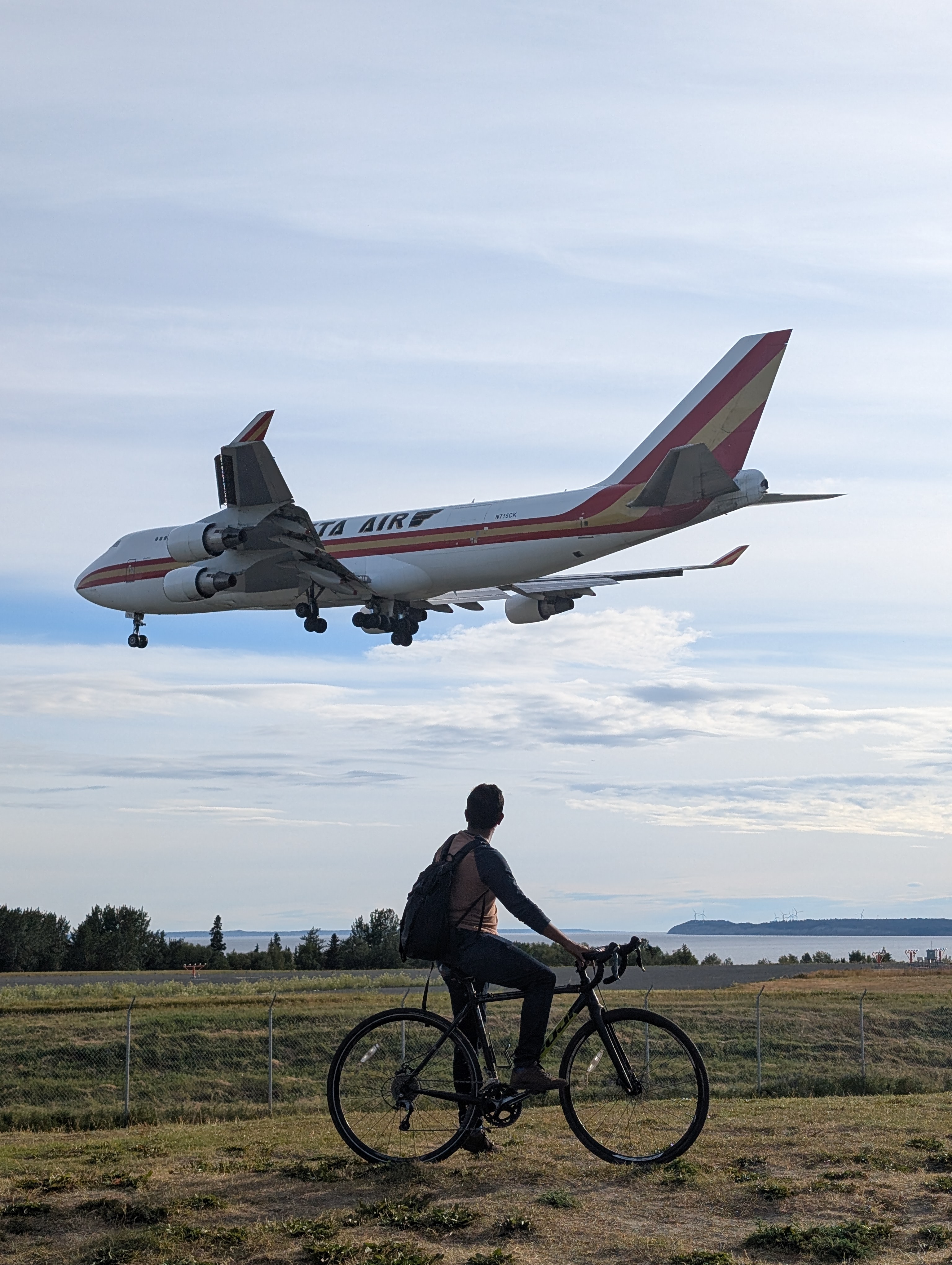
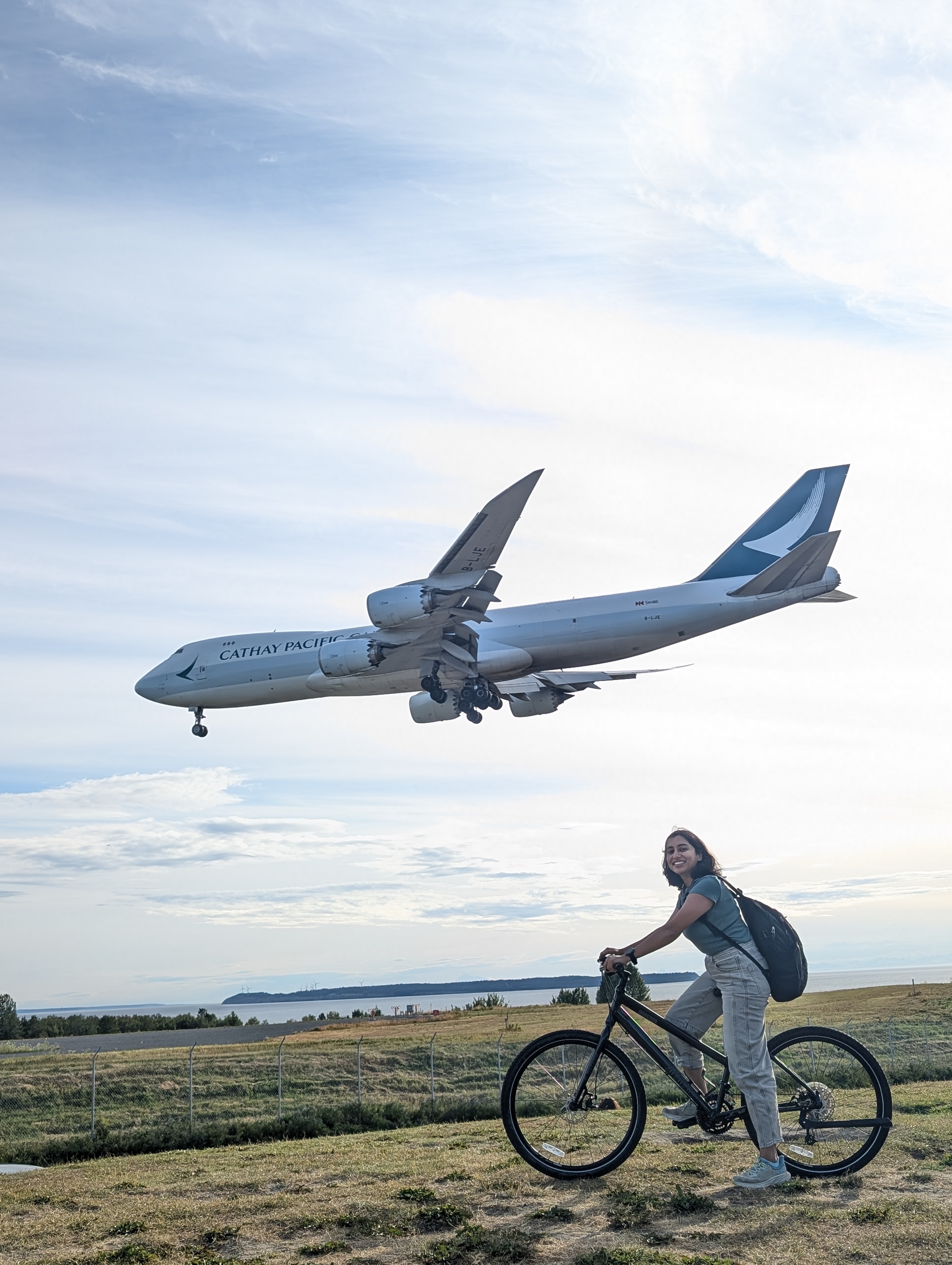
Tony Knowles Coastal Trail was not my first pick for a bike trail. I’d wanted to bike the entire Moose Trail, a 33 Mile loop which includes the coastal trail and runs through the city. Sibi had wanted an easier ride, and he had it imprinted in his brain that the coastal trail was only 11 miles long. It was 25 miles long for the round trip, a fact I repeated through the onwards ride, that he chose to disbelieve the entire way. At 5 miles, we made a stop near the commercial cargo-airplane landing strip and marveled at flights flying right above our heads, taking dozens of videos and photos aiming for the perfect shot. “We’re half-way there, right?” he said. “Halfway to the halfway point,” I said. He shook his head in denial.
The trail was the prettiest trail I’ve ridden on so far: it was tree lined, open to the ocean, with no smells from smoked cigarettes or marijuana. We could smell the salty, sunny air, feel the 20 degree Celsius breeze, ride on a well-paved bike path with only other bikers and the occasional pedestrian for company. Sibi and I marveled at the number of friends and families we saw walking along the path, “Do they just walk, chatting for 11 miles?” he asked.
The last onward mile was the hardest! It was a steep 180 m ascent, and I had to drop to the lowest gear and humbly huff and puff my way to the top of the hill to the mid-point of the ride. At this point it had finally dawned on Sibi that we were halfway through, but he refused to be realistic about the time it would take us to get back. We’d gotten here in an hour and a half. Our friend called, asking about dinner plans, and I realized that I’d completely lost track of time because of the bright sun upon us. Our way back was through winding city roads, and left us frequently confused and lost, requiring us to interpret two paper maps with our shopkeeper’s helpful squiggles and scribbles. We got back to the bike-store at 10:15 PM. The sun was bright as day outside.
Bike path with a distant Sibi, around 9:30 PM.
The next morning we had an early start, driving our way to Seward, a town over a 100 miles away for a Fjords cruise. Sibi drove the entire way, and I picked music. It worked against both of our comfort zones.
About 30 minutes away from Seward, highway traffic ground to a stop. A minute of inching later we saw why. There was a tall, black dog running alongside and against cars on the highway. My first thought was wondering if this is usual in Alaska, but the dog looked pretty clueless on how to behave which made me think it wasn’t expected. I snapped a picture of the dog on the street and posted it on Reddit. “Collared dog running alongside State Highway 9” I’d said as the title. Ten minutes later, four comments arrived with the same message: ‘No one calls it that. It’s Seward Highway’. I updated the title, choosing to appease the angry Redditors. We checked into our day long cruise and made our way aboard, losing internet service along the way.
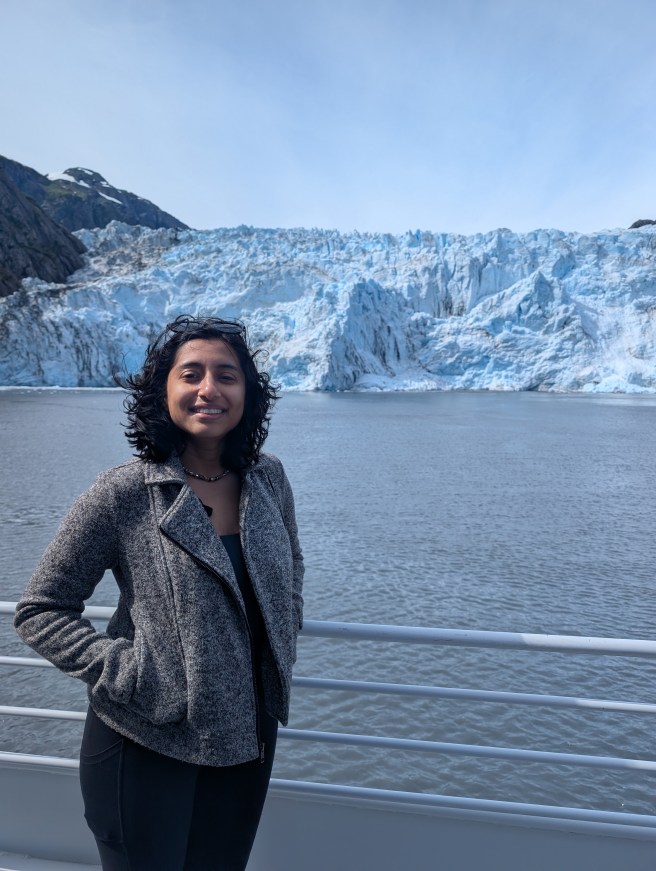
We spent the next 7 hours at sea, watching whales feed, otters play, puffins dive, and glaciers calve. None of these were actions I’d expected to see, ever. Many many photos and incredible views later, we made it back to land.
I opened Reddit on our way back, and delighted! One kind Redditor had responded, “No this is not normal. I called Alaskan Highway Patrol and posted this on Facebook Alaskan Lost Pets group. Will share if we find an update”, and sometime later, “edit: Dog has been reunited with the owner”. I felt silently proud, while Sibi declared this as our best internet moment. (Reddit Link here if you’re a comments-reader)
Another 100 miles of driving later, Sibi returned the car to rental with blood-shot eyes (from concentrating on his driving – he’d driven the whole way in perfect upright posture, 10 and 2 hands on the steering, and had seemingly not blinked enough).
Oh! Prior to all this, that morning before we left for our day of driving, Sibi dropped his phone and the screen stopped working. This is the third time he’s broken his phone on a trip, and this was probably the best circumstance to break his phone, to be fair. The first time was in Hawaii where he dropped his phone onto a Caldera, a high density rock that shattered his screen into a million pieces like a modern sculpture, and the second time was in Zion national park, where after a day of hiking and taking hundreds of photos, Sibi dropped his phone into the Narrows and lost it forever. So all things considered, innocently dropping his phone from the couch onto the floor of our Airbnb was laughably easy to resolve. We stopped at Bestbuy on our way to brunch the next day and picked up a new phone. He was set up by mid-day. The folks at Bestbuy were sluggish – we asked for a Pixel 9A and the store-assistant unapologetically said, “Ah don’t worry, someone will be with you in 10 minutes to show you the phone”.
Brunch was a similar, slow affair. We finally met up with our friends Sandy and Prad at brunch. It was their turn to be confused by Alaskan hospitality and small-talk. One of the customers at a neighboring table at brunch remarked multiple times at our spread. “I wish I’d gotten fruits like they have! That looks so nice!” she said, on two occasions. Sandy smilingly responded in Tamil, “Wow, it seems like she’d just eat with us if given a chance”. We laughed – it was exactly how we’d felt the last two days! We were glad to have more New Yorker energy in Anchorage – ever-rushed, and usually impolite.
We drove to Matanuska Glacier for a walk through the ice with two guides. The drive was long, and rainy. When we got off at Matanuska it was bitterly cold, and we donned all of our minimal winter-clothes we’d brought with us. One of the guides snapped at us for not having checked the weather before arriving – none of us even had rain-jackets. On the walk they were nicer, and the Glacier walk felt other-worldly: we were in the middle of ice in every direction, walking with crampons and ice boots in the middle of Alaska. Three days ago we’d been in the hustle of summer in midtown NYC.
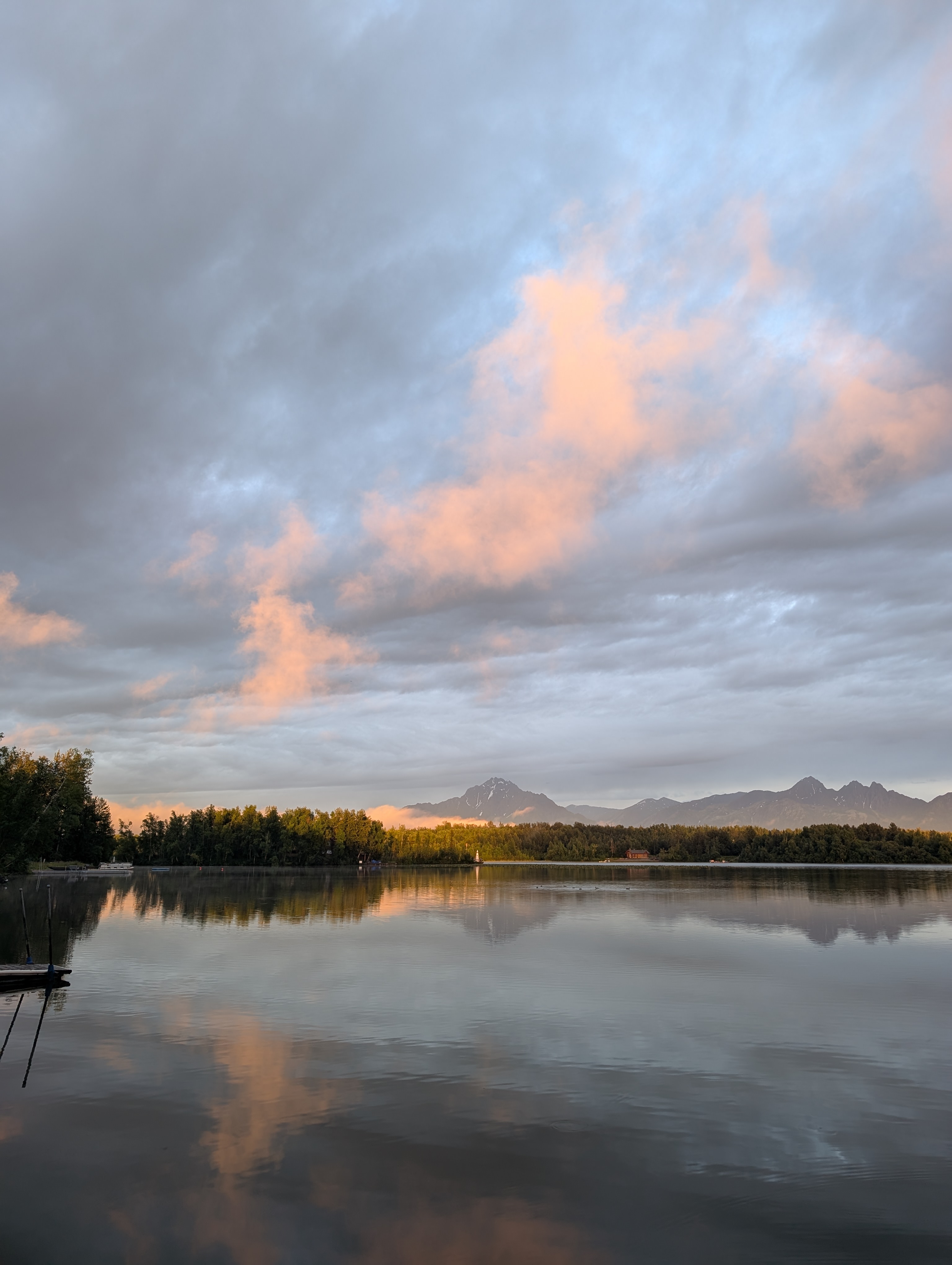
Two hours of walking around left us happy and content, and we made our way back to the new Airbnb in Wasilla that our friend and Alaskan resident, Sathvik (who we were yet to meet on the trip) had booked. It was a beautiful lake-facing property that the sun shone through even at the 8 PM we checked-in at.
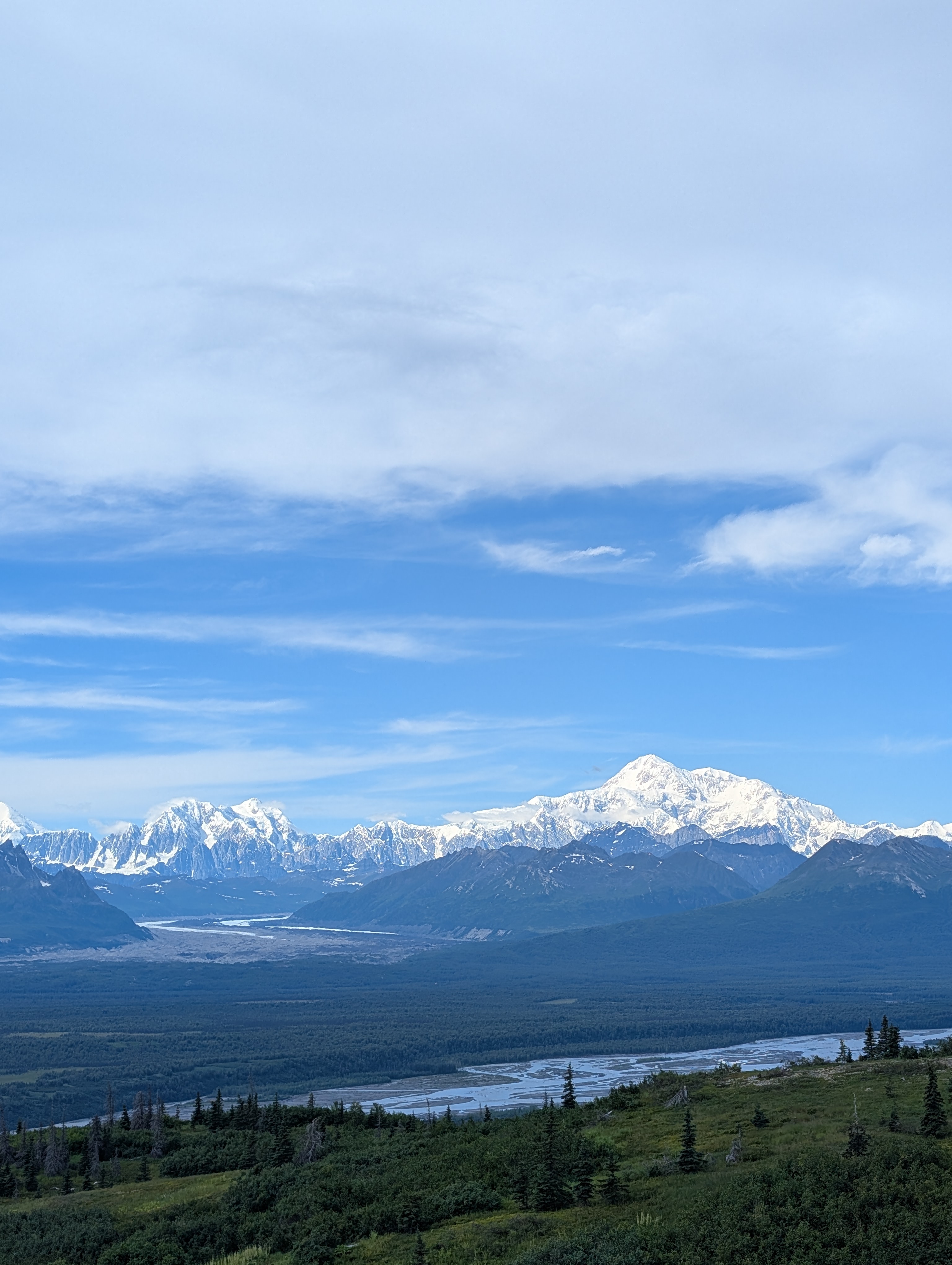
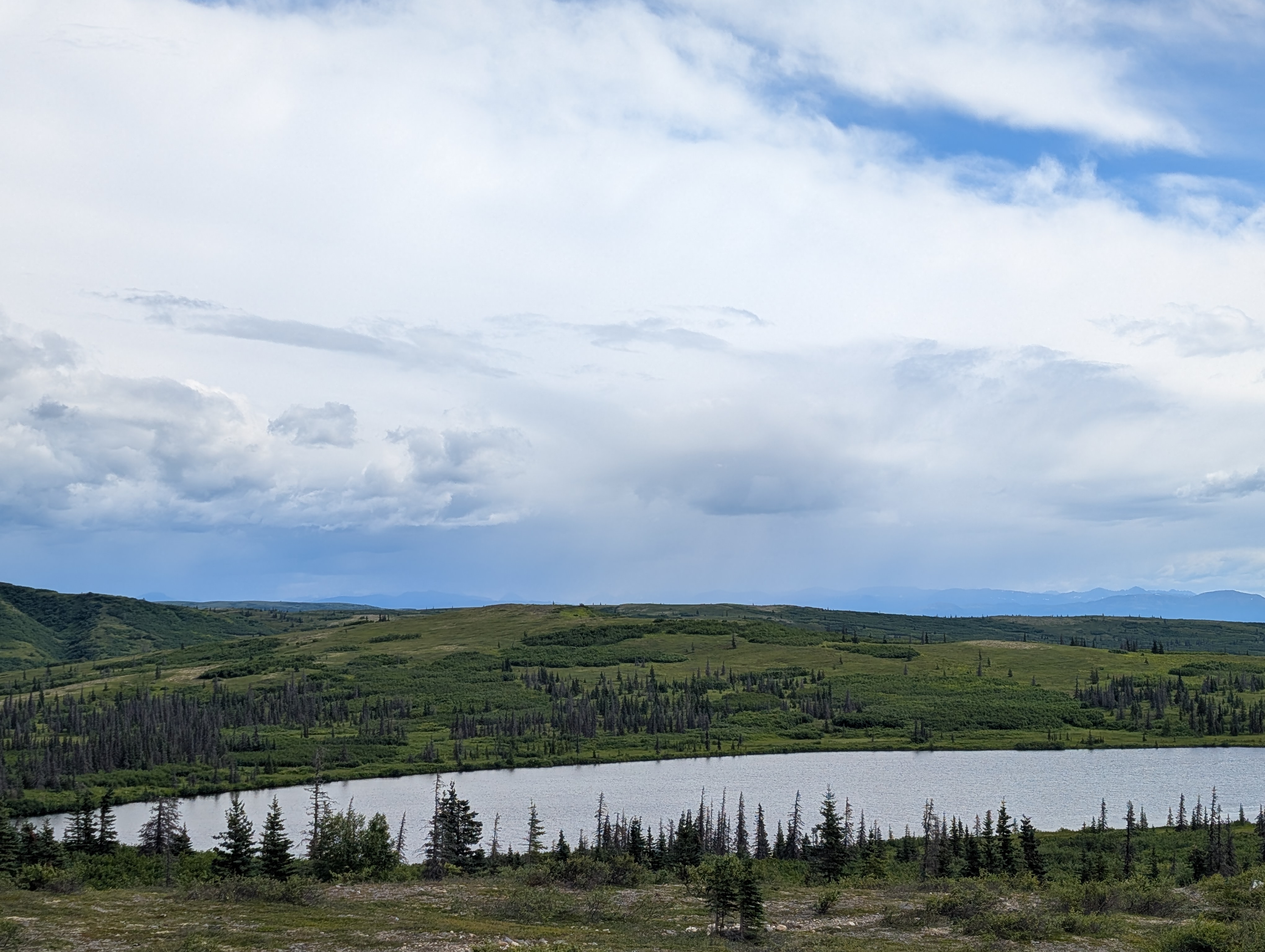
The next day, we drove up to Denali State Park in a crowded Compact-SUV packed with 5 grown adults. We spoke about bears the entire way to Denali State Park, Prad and Sibi vowed to move to Alaska together, and Sandy made some well-meaning comments that we reacted to with shock and defined as hot-takes. Good ol’ road trip vibes! The hike we’d painstakingly picked turned out to be a perfect 7 mile hike up a hill to Curry Ridge with incredible views of Mount Denali and surrounding areas on a picture-perfect day. Along the hike, we clapped, yelled “Hi Bear”, and had a bear-bell ringing the entire time. No one would have been in any doubt that we were not local Alaskans.
A beautiful hike and a 160 dollars in cooking supplies and groceries later, we were home, showered, and prepping dinner together. Multiple people at Target had commented on our 160 dollars of supplies that I felt the need to call it out here. We ate most of it, and I packed up the rest of it back to NYC, primarily out of guilt.
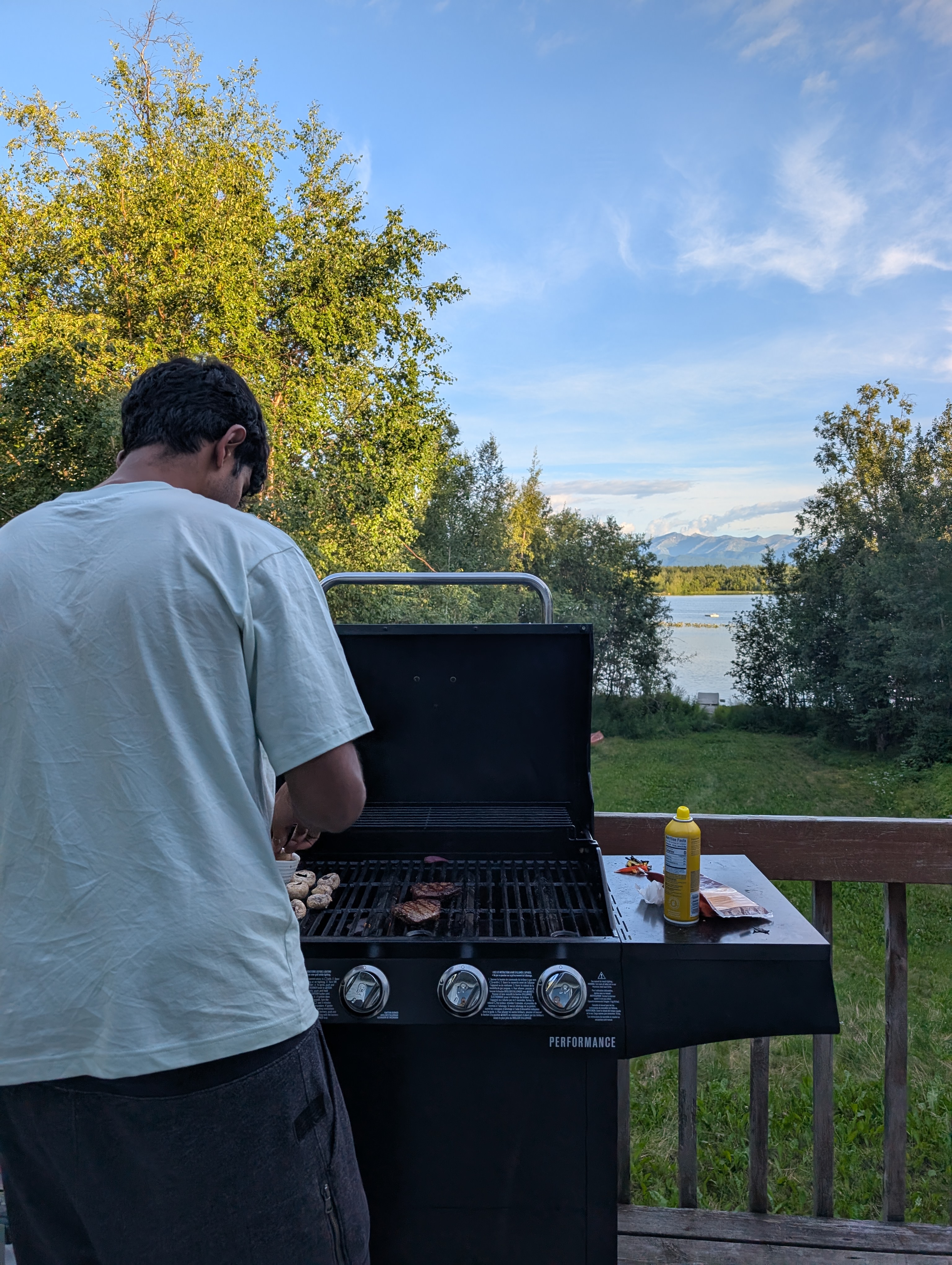
Barbecue was utterly perfect: all of the meat patties, Alaskan salmon, vegetables, mushrooms, and faux-meat patties for us vegetarians turned out to be delicious, and we settled into a game of Poker to end the night. Sandy was the big winner, taking home an additional $10 that the other 4 of us combined had lost.
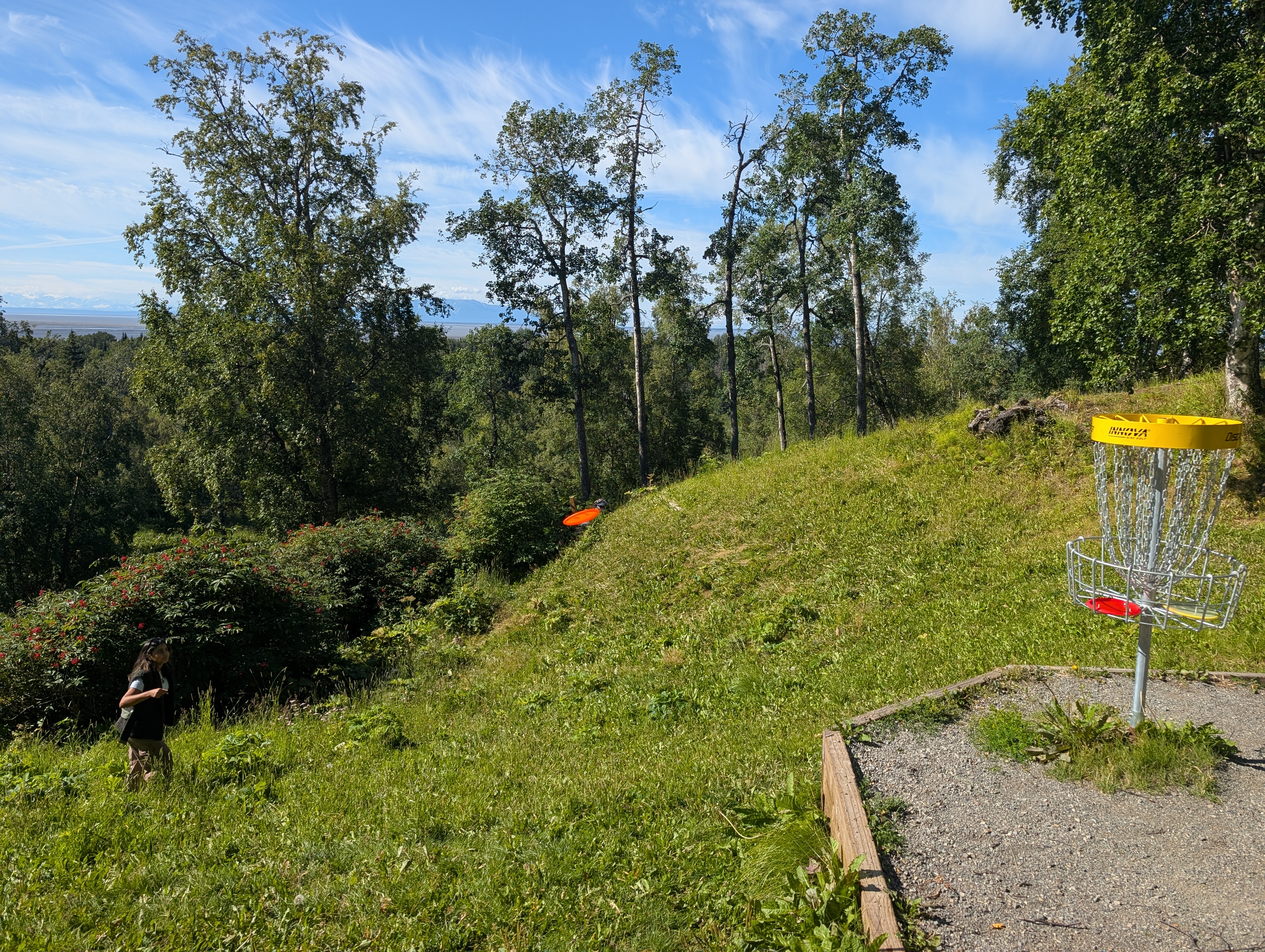
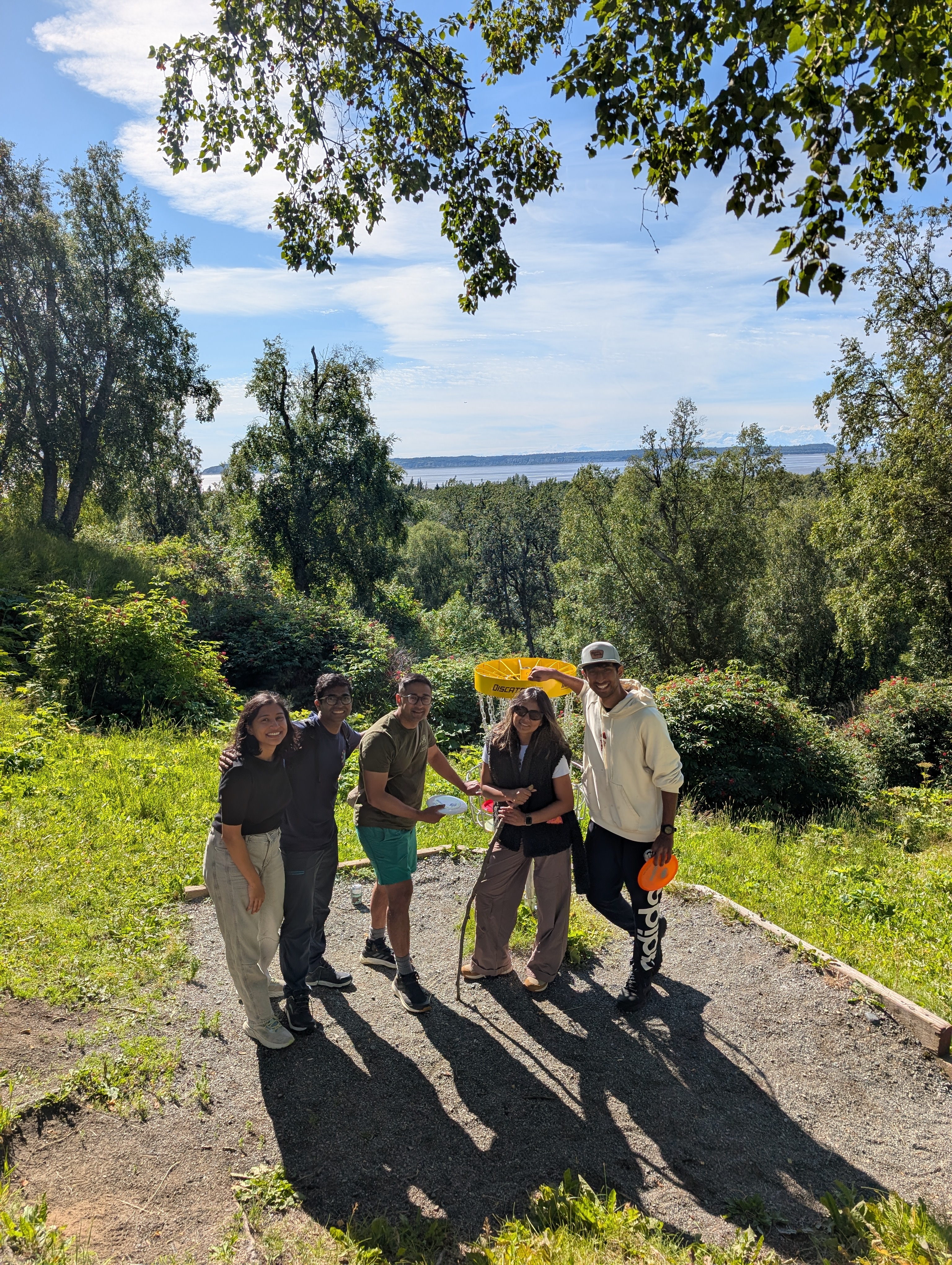
On Sunday we headed to a Disc-Golf course in Kincaid Park. There was something to the competitiveness it lent to the otherwise regular hiking day that we thrilled in, and the leisurely pace under a cool sun and beautiful winds made the day feel pretty-perfect. We headed back to Moose’s Tooth for lunch, ordered too much food, and made our half-hearted way to the airport for our overnight flights back to NYC.
We bid Alaska our goodbye with our promises to return in the winter, and play more disc-golf in New York. All in all, a pretty amazing trip.
Dalrymple can always be trusted to create poetic travelogues, and his year in Delhi in this book is not a letdown! He traverses the lines between anecdotal story telling and lessons in history easily, although not as masterfully as his other books.
My own visits to Delhi — short days in mid-2000s — made some of his 1980s references feel distant; I also hadn’t realized the depth of Mughal influence in Delhi. One passage to me, in particular, captured the way Dalrymple weaves history, legend, and the enduring presence of the mystic in Delhi:
“Standing there in the dark temple, as the rain lashed down on the ghats, I realized that of course it must have been the sadhus here on the banks of the Jumna who had preserved this most ancient of Delhi legends: the story of the Ten Horse Sacrifice and, long epochs before that, the tale of the sacred shastras emerging from the river flooded by the monsoon cloudburst. It was a wonderful legend: the mythical story of Delhi’s first birth linked with the undeniable fact of its annual rebirth in the monsoon rains.
Indraprastha had fallen; six hundred years of Muslim domination had come and gone; a brief interruption by the British was almost forgotten. But Shiva, the oldest living God in the world, was still worshipped; Sanskrit – a language which predates any other living tongue by millennia – was still read, still spoken. Moreover, the sadhus and rishis – familiar figures from the Mahabharata – remained today, still following the rigorous laws of India’s most ancient vocation: giving up everything to wander the face of the earth in search of enlightenment; renouncing the profane in the hope of a brief glimpse of the sacred. In these wet and dishevelled figures sitting cross-legged under the neem and banyan trees of the river bank lay what must certainly be the most remarkable Delhi survival of all.”
Faroe Islands: Not spelt Farrow, but can be spelt Faeroe instead. The official language is Faroese. They’ve been inhabited since the 4th century, and settled/ruled/owned by Norwegians, English, Danes, Icelandic. If we were to enforce a narrowly won referendum from 1946, Faroe Islands would be an independent state, but that was annulled by the King of Denmark, and so the islands belong to (surprise, surprise!) the Danish Kingdom. Sorry, where is this archipelago, you ask? Midway between Iceland, Norway and the UK in the Atlantic Ocean.
Christmas Island: Closer to Indonesia than to Australia which governs the land, Christmas Island hovers just about 350 km south of the Java Islands. It was named so because of its discovery on Christmas Day in 1643 by an English sea captain with an allegiance to the East India Company. The British lost the island to the Japanese during World War II but eventually reclaimed it. And later, the British Colony of Singapore sold Christmas Island to Australia for $20 Million in 1946 for its Phosphate mines. English, Malay, Mandarin, Cantonese, and Hokkien are the primary spoken languages, and the island boasts of a population of under 2000 people. Christmas Island is known for a natural world’s phenomenon as well, but more on that later.
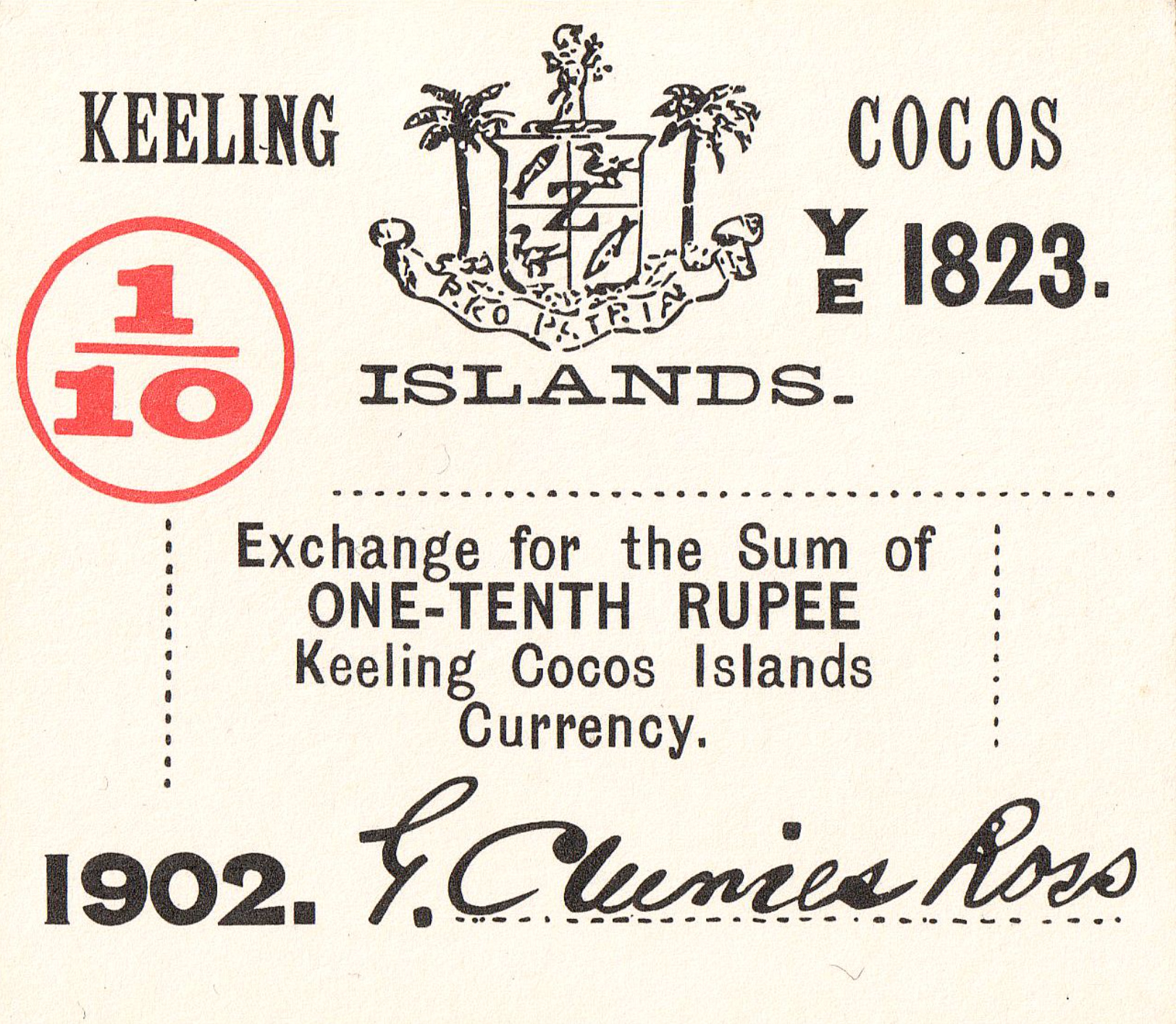
Cocos (Keeling) Islands: I’m cheating a little bit by picking this next, since it shares most of its history with Christmas Island. Further south of Indonesia (and still nowhere close to Australia), Cocos Islands were also purchased by Australia from the British Singapore in 1955. The island was discovered by William Keeling in 1605, but not inhabited until a certain John Clunies-Ross stopped by 200 years later, planted the flag of the Union Jack, and left with the notion of bringing his wife and family to settle in these islands. Before he could do that though, another wealthy Englishman Alexandre Hare, had the same idea. Except, instead of bringing his family, Hare brought in Malay women to create a ‘voluntary’ harem and settled in the islands. When John Clunies-Ross arrived with his family and some soldiers, a feud grew between the two Brits, with John ultimately winning the islands from a distraught Alexandre whose ‘wives’ had run away or left him for the newly-landed soldiers. John then took over administration of the islands, and even minted his own currency, the Cocos Rupee.
The Brits officially controlled the islands from 1906, even though all the land belonged to John. These islands have a fascinating history in both the world wars, owing to a telegraph station the Brits built here, on an island that they helpfully called ‘Direction Island’. Today, the islanders (all 600 of them) predominantly practice Sunni Islam, and speak Malay. The islands are named so after their abundance of coconut trees.
Related, and absolutely fascinating: The annual red crab migration of Christmas Island occurs around October/November each year, and sees an estimated 40 million red crabs coolly walking, climbing and shimmying across the island to get to the ocean in order to breed. The male crabs start earlier, leaving their homes in the jungle to reach areas around the ocean where they create burrows and wait for their potential female mates. The females arrive fashionably late, and spend an additional couple of weeks incubating the eggs and making a further trip to the ocean to finally release the larvae into the water. Whales migrate to the coast of Christmas Island to feast on the newly released larvae. The baby crabs that survive all this then make the treacherous journey back to the jungles in the middle of the island. Here’s a video of all this chaos.
Things I learnt from this video:
There are crab infrastructures created in Christmas Island each year: this includes crab bridges, detours, and underpasses.
Crabs are cannibals. They feed on the ones that don’t make it to the ocean.
Crabs can climb over absolutely anything.
A female red crab can release up-to 100,000 eggs at once.
Christmas Islanders are alarmingly calm about red crabs.
Rutger Bregman subtitles this book as a ‘Hopeful History’, and as someone who has read and feared Lord of the Flies, it served precisely as that. Some of the points raised in the book were so poignant that I had to re-read sentences several times, and review the supporting evidence over and over before even beginning to accept it.
Over 50% of soldiers in the front lines of WWII did not shoot. On a cold wintry November morning in 1943, Colonel Samuel Marshall decides to do something groundbreaking: he decides to interview groups of servicemen in war.
…he found that only 15 to 25 per cent of them had actually fired their weapons. At the critical moment, the vast majority balked. One frustrated officer related how he had gone up and down the lines yelling, ‘Goddammit! Start shooting!’ Yet, ‘they fired only while I watched them or while some other officer stood over them’.
While some of Colonel Marshall’s claims have been doubted, the evidence supporting his claim that “most soldiers are not killers” has only been growing, and becoming further irrefutable. Studies from the Battle of Gettysburg during the American Civil war showed that most of the 27 thousand muskets retrieved from the battlefields were fully loaded. Since priming a musket takes several steps, and more importantly, takes timenot spent shooting, this is truly surprising. More shocking still, is that over 12 thousand of them were double loaded, and half of those were triple loaded. Much later, historians deciphered the sentiment behind this: loading a gun was an excuse to not shoot it.
Most of the British soldiers killed in the Second WW were killed remotely, over 85% of them through grenades, mortars, aerial bombing, land mines, and booby traps. Over time, weaponry has gotten better at remote violence, in a way to overcome the issue of soldiers on the front line being unwilling to shoot at each other.
In the face of such evidence, what I was left pondering about was the cause of violence today: in cities, where a single shooter, or a car driver murders dozens. I wonder what Rutger Bregman says about that.
From the discovery and story telling about Easter Island, to how the government reacts to situations of crisis, Rutger Bregman’s hopeful history is not only compelling in rewriting how we think about humanity, but also points out the dangers of being too cynical. In the aftermath of Hurricane Katrina in New Orleans, it can be argued that the government’s misconception of the state of law and order in the city caused the governor to take drastically violent measures when they were not necessary – literally taking away innocent lives in effect.
Bregman also warns us against using empathy as the solution to our problems today: firstly because it is a very narrow tool – one that takes time to build. And secondly, because empathy alone will still lead to consequences we do not want:
One thing is for certain: a better world doesn’t start with more empathy. If anything, empathy makes us less forgiving, because the more we identify with our victims, the more we generalize about our enemies.
From debunking the Stanford Prison Experiment, to diving into details of shipwrecks that emulated the set-up of Lord of the Flies to debunk the anarchist explanations of human-motivations, this book does it all, and serves as a powerful reminder of not only what Humankind could be, but what Humankind already is – and it’s an uplifting read.
A high school physics teacher once enforced a rule in his classes which still stands out to me as the single best method in learning — ‘You’re only allowed to use a new word once it’s been defined and everyone agrees on its meaning’.
What did this look like in practice? When learning about objects moving at a constant speed, for example, we weren’t allowed to use terms like force, acceleration, or gravity. If we wanted to introduce a new word, we had two choices: take the time to define it for the class, or stick to concepts we’d already established.
That same principle of establishing shared understanding before using a term feels increasingly rare in social discourse.
During conversations about policies, politics, and beliefs, I’ve often heard someone in the group make a quip along the lines of, “That is an X argument” where the X could be ‘communist’, ‘conservative’, ‘sexist’, or the like. It seems intelligent in its premise: someone is able to summarize a nuanced and lengthy argument into a single, succinct label.
Sometimes however, the single, succinct label ‘X’ is used to discredit someone’s nuanced argument. Instead of moving the discussion forward, it’s weaponized to attack the speaker and discredit their argument quickly. Too quickly. Now, the burden of proof shifts: the speaker must defend herself against the label, rather than have her original argument considered on its own merits. And because labels come preloaded with assumptions and baggage, choosing not to reject the label can imply tacit acceptance of everything that comes with it.
Potato stunned by carrot’s labeling
Scott Alexander calls this the Non-Central Fallacy—when a label technically applies to something but leads us to reject it based on extreme or unrelated associations. His article shows someone dismissing a scientific concept as “sexist,” not because it devalues women, but because it talks about sex differences at all. The word might technically apply, but it’s doing more to stop the conversation than to clarify it.
″Evolutionary psychology is sexist!” If you define “sexist” as “believing in some kind of difference between the sexes”, this is true of at least some evo psych. For example, Bateman’s Principle states that in species where females invest more energy in producing offspring, mating behavior will involve males pursuing females; this posits a natural psychological difference between the sexes. “Right, so you admit it’s sexist!” “And why exactly is sexism bad?” “Because sexism claims that men are better than women and that women should have fewer rights!” “Does Bateman’s principle claim that men are better than women, or that women should have fewer rights?” “Well…not really.” “Then what’s wrong with it?” “It’s sexist!”
So what can I do about it? The next time a label gets thrown into a conversation in an attack, this is a note to myself to pause, turn around, and ask the label-lover to define it.
“What do you mean by X?” or “Why do you think this is X?”
Maybe that way, the onus of defense goes back to the wielder of labels, and we can open the door to more meaningful dialogue with respect, nuance, and shared understanding.
Kaikeyi, a character from Ramayana is rich with possibilities. She’s one of the wives of Rama’s father, the cause of Rama’s exile from Ayodhya, and by all accounts of the Indian mythology: an egotistic female filled with jealousy and surrounded by bad advisors.
Kaikeyi by Vaishnavi Patel’s parallel with Madeline Miller’s Circe is impossible to ignore: they’re both books that centered on a smaller female antagonist from the Epics they belonged to, and aimed to rewrite the story with a new, feminist perspective.
That’s also, unfortunately, where the similarities end. Where Circe is poetic, Kaikeyi is trite. Where Circe is a character still bound to make mistakes and missteps, Kaikeyi is ever misunderstood and mistaken. The magical elements in Kaikeyi are only part explained, and when they are – they seem rather rudimentary anyway. Some of the supporting reasons to believe in this positive spin of Kaikeyi are also very forced – particularly Ravana’s story arc.
All in all, this isn’t a read I would recommend, but if it’s on your bookshelf already – nothing sharp I would say to dissuade you either.












 Perplexed Potatoes